2026 Summer Power Crisis: Will India Face a Power Shortage?
Updated: April 2026 • Author: BijliBabu Team • Based on Global Energy Security Analytics
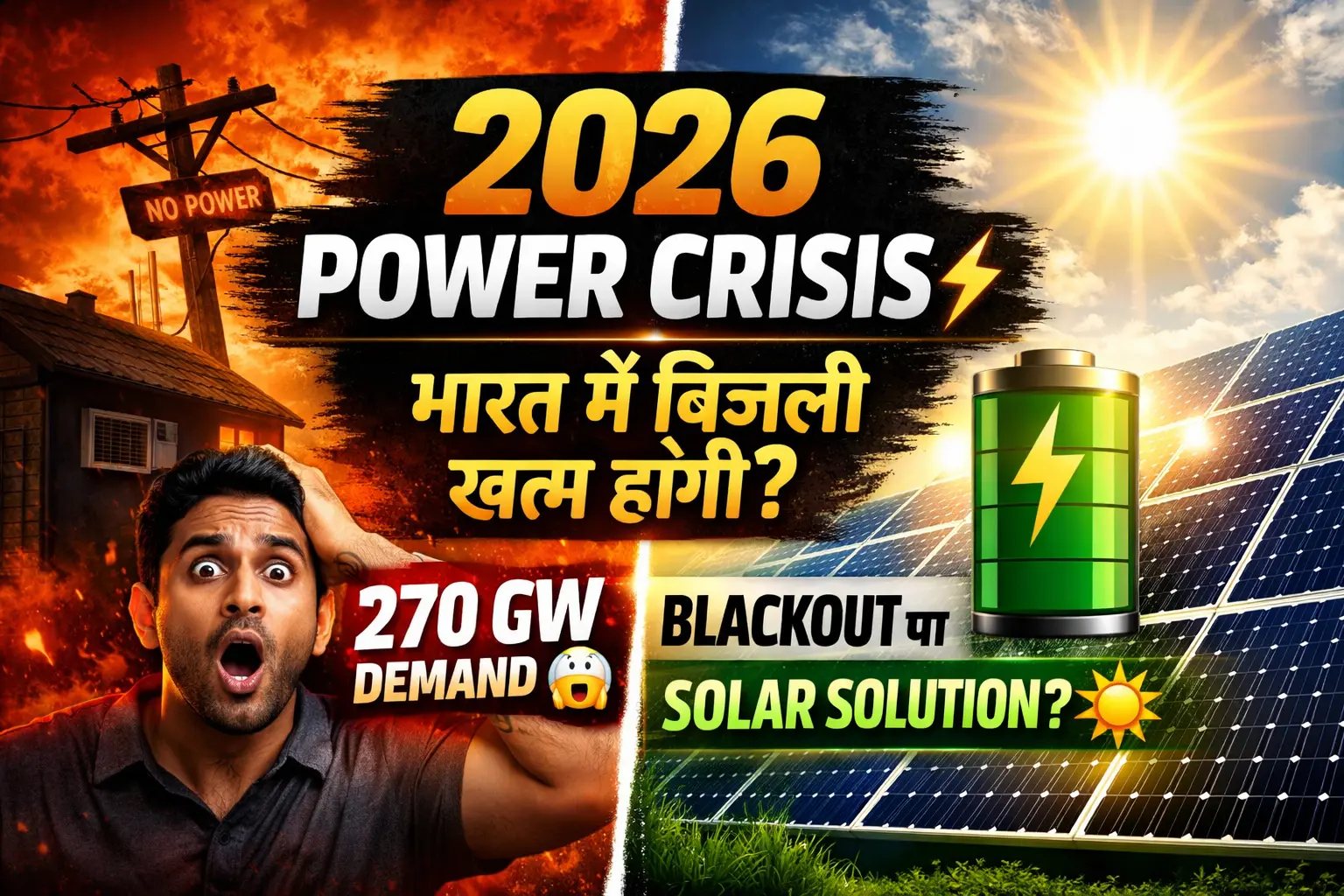
2026 Summer Power Crisis is an important concept that every electricity consumer should understand before installing a solar power system or smart meter infrastructure in their residence.
As the brutal summer of 2026 approaches, meteorological models are predicting historically devastating heatwaves across the Indian subcontinent. With temperatures projected to consistently breach 45°C, an unprecedented surge in cooling loads (HVAC systems and commercial refrigeration) is imminent. The Ministry of Power has officially projected that India's national peak electricity demand will shatter previous records, touching a staggering 270 GW (Gigawatts). Compounding this domestic pressure is severe geopolitical volatility. The ongoing war in the Middle East has catastrophically disrupted maritime trade routes in the Red Sea, critically delaying Liquefied Natural Gas (LNG) imports. This has effectively hobbled India's gas-based power plants, which are traditionally utilized as rapid-response "peaking" units to stabilize the grid during sudden demand spikes.
With skyrocketing demand and compromised gas logistics, headlines are dominated by the fear of an impending "India me bijli ki kami" (power shortage). Will the grid collapse? Will millions face scheduled blackouts, causing their prepaid smart meters to become useless? Despite the dire external optics, the Government of India remains highly confident in its infrastructural resilience. Through a strategic, multi-tiered backup plan combining massive coal reserves, decentralized rooftop solar via the PM Surya Ghar initiative, and cutting-edge Battery Energy Storage Systems (BESS), the grid is actively fortified. In this comprehensive technical guide, we will mathematically deconstruct the 270 GW demand matrix and explain exactly how the nation plans to keep the lights on.
Table of Contents:
- 1. 2026 Summer Power Crisis: What Is the Difference?
- 2. The Middle East Conflict: Disrupting the LNG Supply Chain
- 3. The Strategic Backup: Synergizing Coal, Solar, and Wind
- 4. Calculation Math: Balancing the 270 GW Payload
- 5. BESS Integration: Shifting Daytime Solar to Evening Peaks
- 6. Case Study: How Rooftop Solar Prevented a State Blackout
2026 Summer Power Crisis: What Is the Difference?
Analysts frequently question the difference between historical summer load profiles and the unique threat matrix of the 2026 Summer Power Crisis. The difference lies fundamentally in the evolution of 'Consumer Behavior' intersecting with extreme 'Climate Volatility'.
In previous decades, the Indian power grid experienced its primary stress during the "Evening Peak" (typically 8:00 PM to 11:00 PM), driven by domestic lighting and residential cooling as citizens returned home. However, 2026 marks the consolidation of a massive, sustained Daytime Peak. Because of unyielding daytime heatwaves, commercial entities, factories, and residential households are running heavy inductive HVAC loads simultaneously at 2:00 PM. Furthermore, the deployment of highly sensitive smart meters logging Apparent Power (kVAh) exposes the massive reactive power (inefficiency) stressing the grid. The combination of a 270 GW dual-peak (day and night) and compromised Middle Eastern gas logistics makes this summer structurally different. Consequently, relying solely on baseload thermal generation is no longer viable, forcing a rapid pivot to decentralized solar networks and dynamic battery storage.
2. The Middle East Conflict: Disrupting the LNG Supply Chain
India utilizes gas-based power plants not as baseload generators, but as highly agile "peaking" plants. They can be fired up in minutes to inject emergency power when the grid frequency drops. However, the Middle East geopolitical conflict has severely compromised this strategy:
- Logistical Bottlenecks: With the Red Sea effectively blockaded for commercial transit, LNG tanker fleets are forced to navigate the Cape of Good Hope, adding weeks to transit times and delaying critical fuel deliveries to Indian ports.
- Economic Unviability: The extended maritime routing has exponentially increased freight insurance and spot market LNG prices. Producing electricity from imported gas has become mathematically unviable compared to domestic tariff caps, forcing many gas plants to sit idle.
- Grid Vulnerability: Without the rapid-response capability of gas plants, the grid must rely entirely on slower-ramping thermal (coal) and weather-dependent renewables to absorb sudden shock loads.
📊 Audit Your Consumption to Protect the Grid!
Are your obsolete appliances drawing excessive reactive power? Calculate your exact payload and avoid algorithmic penalties:
Appliance Load Calculator Audit Your Power Factor3. The Strategic Backup: Synergizing Coal, Solar, and Wind
To proactively neutralize the 2026 Summer Power Crisis and silence fears of an "India me bijli ki kami", the government has engineered a robust "Three-Tier" generation strategy:
- Baseload Coal: The Ministry of Power has eliminated logistical bottlenecks, ensuring thermal plants possess a massive buffer stock of coal. Furthermore, regulatory mandates compel all thermal generators to operate at 100% Plant Load Factor (PLF) and blend a mandatory 6% of imported coal to maximize absolute output.
- The Solar Vanguard: The most potent weapon against the "Daytime Peak" is solar energy. When 2:00 PM HVAC loads threaten to crash the grid, solar irradiance is concurrently at its absolute zenith. Aided by millions of subsidized rooftops installed via authorized PM Surya Ghar vendors, India's 80+ GW of solar capacity effortlessly absorbs the daytime shock.
- Wind Energy Synergy: As the sun sets and solar generation flatlines, coastal wind corridors in Gujarat and Tamil Nadu experience enhanced evening thermal drafts. This wind generation perfectly offsets the loss of solar, bridging the gap during the critical 7:00 PM evening peak.
4. Calculation Math: Balancing the 270 GW Payload
How does the national grid mathematically absorb a 270 GW impact without buckling? Let us deploy Calculation Math to evaluate the projected generation stack during peak thermal stress:
| Energy Generation Vector | Projected Peak Output (GW) | Strategic Grid Function |
|---|---|---|
| Thermal (Coal + Minimal Gas) | Approx. 190 GW | Provides the unyielding, uninterrupted baseload. |
| Photovoltaic (Utility & Rooftop Solar) | Approx. 45 GW (During 2:00 PM Peak) | Directly offsets massive commercial and residential HVAC loads. |
| Hydro, Wind & Nuclear Assets | Approx. 35 GW | Provides agility; ramps up rapidly during evening transition. |
| Total System Capacity | ~270 GW (Equaling Max Demand) | Absolute Supply-Demand Parity achieved. |
Analytical Conclusion: Despite the absence of peaking gas plants, the mathematical synergy between maximized coal baseload and massive daytime solar offsets ensures grid stability. If you experience a sudden disconnection, it is highly likely a localized distribution fault or your smart meter wallet has depleted, not a national grid collapse.
5. BESS Integration: Shifting Daytime Solar to Evening Peaks
The primary limitation of solar power is its transience—it vanishes exactly when the evening residential peak begins. To counter this, 2026 marks the aggressive deployment of Battery Energy Storage Systems (BESS).
India has commissioned gigawatt-hour (GWh) scale Lithium-Ion and Vanadium Redox flow battery banks adjacent to massive solar parks. These utility-scale batteries absorb surplus, ultra-cheap solar power generated at noon. At 7:00 PM, as solar yields drop and lighting/cooling loads spike, these BESS units instantaneously discharge their stored power back into the macro-grid. Operating with millisecond response times, BESS effectively replaces the role of the disrupted Middle Eastern gas plants, rendering the grid resilient against evening demand shocks.
6. Case Study: How Rooftop Solar Prevented a State Blackout
The Incident: During an unprecedented early summer heatwave, the state grid of Uttar Pradesh (UPPCL) faced a catastrophic scenario. Demand spiked past 28,000 MW, and concurrently, a massive 1,000 MW thermal turbine tripped due to a mechanical fault. Traditional operating procedures mandated immediate, rolling blackouts across multiple districts to prevent a cascading grid failure.
The Strategy: Over the previous 24 months, the state had aggressively promoted new grid-tied connections under the PM Surya Ghar initiative. Over 500,000 urban households had deployed 2kW and 3kW solar arrays.
The ROI: At 2:30 PM, the exact moment the thermal plant failed, these decentralized residential rooftops were operating at peak efficiency. They autonomously injected over 1,500 MW of surplus, net-metered power back into the local distribution grid. This decentralized "Virtual Power Plant" instantly absorbed the 1,000 MW deficit. The grid frequency stabilized, and the state avoided a catastrophic blackout entirely. This real-world stress test forms the bedrock of India's confidence in handling 2026.
Final Conclusion
In conclusion, while the 2026 Summer Power Crisis presents formidable logistical challenges, the narrative of an impending "India me bijli ki kami" is empirically false. The macro-grid is mathematically fortified to handle the 270 GW payload through aggressive coal stockpiling, BESS integration, and a massive decentralized solar fleet. However, grid survival requires consumer participation. You must actively optimize your household footprint: upgrade to high-efficiency appliances, eliminate reactive power penalties, and execute online electricity bill payments promptly to maintain Discom liquidity. Ultimately, the most bulletproof defense against summer blackouts and escalating algorithmic tariffs is to decentralize your own supply. Secure the $950 government subsidy, deploy a high-efficiency Mono PERC array, and isolate your household from the chaos of the national grid. If you experience localized service failures, leverage digital tools to register a formal CGRF complaint online immediately.
Top 10 Frequently Asked Questions (FAQs)
- Will the 2026 summer result in severe nationwide rolling blackouts? No. While the peak demand will test the infrastructure at 270 GW, the synergized deployment of coal baseload, daytime solar, and evening BESS guarantees that the macro-grid remains stable.
- How exactly has the Middle East conflict impacted Indian electricity? Geopolitical tensions in the Red Sea have severely delayed Liquefied Natural Gas (LNG) tankers and spiked freight costs. This has made operating rapid-response gas power plants economically unviable.
- Can decentralized residential solar panels actually save the national grid? Absolutely. The peak thermal load (driven by commercial and residential air conditioning) occurs between 1:00 PM and 3:00 PM—the exact window when solar irradiance (and thus panel output) is at its absolute maximum.
- What is a Battery Energy Storage System (BESS)? BESS refers to utility-scale lithium or flow battery banks that absorb and store cheap surplus solar energy during the day, discharging it into the grid during the evening peak to replace expensive gas plants.
- If the grid experiences a crisis, will my smart meter automatically disconnect my house? No. Your smart meter's internal relay is governed entirely by your financial ledger. It will only disconnect your power if your prepaid balance drops below zero, regardless of the macro-grid's status.
- Will electricity tariffs drastically increase in 2026 due to this crisis? If the Discoms are forced to import highly expensive coal or spot-market LNG to meet the peak demand, they may legally pass this cost to consumers via an algorithmic 'Fuel Surcharge' (FPPCA), slightly elevating per-unit rates.
- Should I install an Off-Grid (battery-backed) solar system to survive the summer? If you reside in an urban center with a stable grid, an On-Grid system is vastly superior due to the ₹78,000 CFA subsidy. Off-Grid systems require massive, unsubsidized battery banks that ruin the ROI.
- How can I personally reduce my footprint to help the grid during peak hours? You can deploy IoT smart plugs to kill vampire standby loads, upgrade obsolete induction fans to BLDC motors, and set your HVAC thermostat to an optimized 24°C (75°F).
- What does the term "Peak Demand" mathematically represent? Peak Demand is the single highest concurrent electrical load requested by all consumers across the national grid at one specific moment (e.g., 2:30 PM).
- If I experience a localized blackout, can I use a smart meter token to get power? No. A 20-Digit Token or 'Emergency Credit' command only resolves financial disconnections. If the physical distribution transformer has failed or the grid is down, the smart meter cannot invent electricity.