
2kW Solar System Price in India 2026: Cost, Subsidy & ROI Guide
Updated: March 2026 • Author: BijliBabu Team • Based on MNRE Financial Guidelines
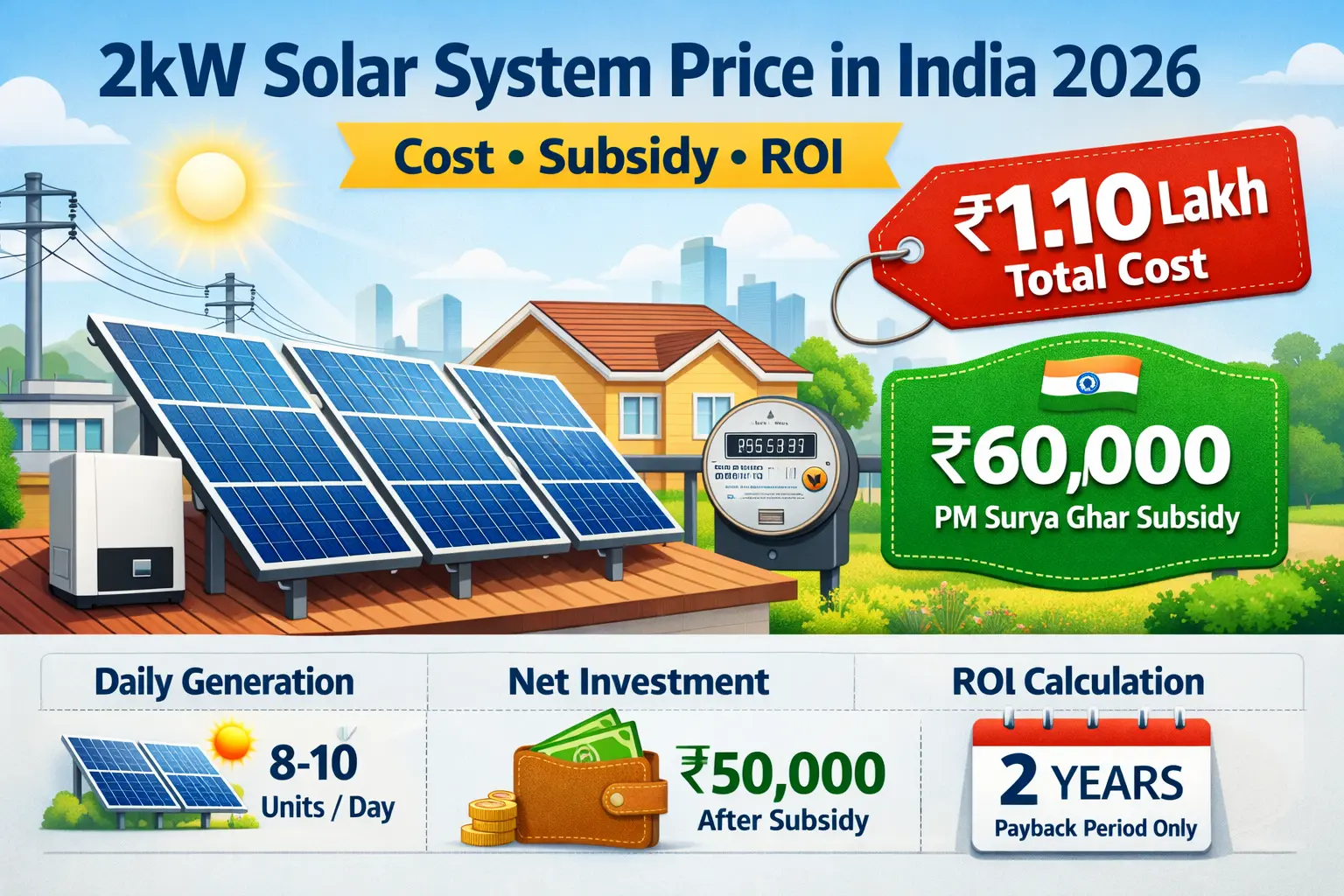
2kW solar system price in India is an important concept that every electricity consumer should understand before installing a solar power system or smart meter infrastructure in their residence.
Are you consistently experiencing "bill shock" as escalating electricity tariffs erode your monthly budget? For the standard urban or semi-urban Indian household operating basic appliances and a single air conditioner, monthly utility invoices can easily become a financial burden. To mitigate this, transitioning to a decentralized 2kW Grid-Tied Solar System is no longer a luxury; it is a highly calculated financial necessity. Furthermore, the aggressive push of the PM Surya Ghar Yojna has drastically lowered the capital barrier to entry for the middle class.
However, navigating the hardware markets and government portals can be overwhelmingly complex. Homeowners frequently ask: "What is the actual out-of-pocket cost?" and "How exactly does the subsidy mechanism function for a 2kW system?" In this comprehensive technical guide, we will audit the exact hardware costs, explain the MNRE subsidy mathematics, and calculate your exact Return on Investment (ROI) for a 2kW installation in 2026.
Table of Contents:
- 1. 2kW Solar System Price in India: What Is the Difference?
- 2. Complete Financial Breakdown: Hardware & Installation Costs
- 3. Understanding the PM Surya Ghar Subsidy for 2kW Systems
- 4. Performance Analytics: Daily Yield and Load Capacity
- 5. Calculating Your Return on Investment (ROI) in 2026
- 6. Strategic Conclusion
2kW Solar System Price in India: What Is the Difference?
When you solicit quotations from solar vendors, you will notice discrepancies in pricing. This variance is strictly due to the architectural type of the system you select. The 2kW solar system price in India fundamentally differs across three main configurations:
- On-Grid System (Highly Recommended): Costs roughly ₹1.10 Lakhs. It utilizes the utility grid as a virtual battery via Net Metering. Importantly, government subsidies are exclusively applicable to this architecture.
- Off-Grid System: Costs surge up to ₹1.6 Lakhs due to the physical battery bank (lithium or tubular) required for storage. It is totally independent but receives zero subsidy. Read our On Grid vs Off Grid Solar System guide for a deeper comparison.
- Hybrid System: Merges both grid-tie features and battery backup, representing the most capital-intensive option available.
2. Complete Financial Breakdown: Hardware & Installation Costs
For maximum ROI, we will focus the audit on the subsidized On-Grid architecture. Hardware prices fluctuate based on OEM selections (like Monocrystalline PERC vs Polycrystalline). Here is the 2026 estimated capital expenditure for a premium 2kW setup: (For a full scalability model, refer to our Solar Panel Price List).
| Hardware / Service Component | Estimated Market Cost (INR) |
|---|---|
| Photovoltaic Modules (4 x 500W TOPCon) | ₹50,000 - ₹55,000 |
| String Inverter (2kW - 3kW On-Grid Rated) | ₹20,000 - ₹25,000 |
| Mounting Structures, DC/AC Wiring & Earthing | ₹15,000 - ₹20,000 |
| Net Metering Hardware & Installation Labor | ₹10,000 - ₹15,000 |
| Total Gross Expenditure (Before Subsidy) | ₹95,000 to ₹1,15,000 |
📊 Calculate Your Precise Financial ROI!
Do not guess your payback period. Input your current utility tariff into our advanced algorithms to generate your exact amortization schedule:
Solar ROI Calculator Appliance Load Calculator3. Understanding the PM Surya Ghar Subsidy for 2kW Systems
To accelerate renewable adoption, the MNRE executes Central Financial Assistance (CFA) disbursements directly to consumer bank accounts. To understand state-level nuances, review our CFA vs State Solar Subsidy breakdown.
The 2026 Subsidy Matrix for 2kW:
- For the 1st Kilowatt: ₹30,000 CFA.
- For the 2nd Kilowatt: An additional ₹30,000 CFA.
- Total Government Injection: ₹60,000.
If your registered vendor invoices you for ₹1,10,000 gross, the government will reimburse ₹60,000 directly to your linked account 30 days post-commissioning. Consequently, your actual net investment is only ₹50,000.
4. Performance Analytics: Daily Yield and Load Capacity
A 2kW solar infrastructure is perfectly engineered to harness solar irradiance for a small household. Given standard Indian weather conditions, a pristine 2kW system generates approximately 8 to 10 units (kWh) of active power daily. This equates to 240 to 300 units per month, perfectly aligning with the government's 300 Units Free Electricity Scheme baseline.
Appliance Load Capacity
A 2kW array can comfortably sustain standard domestic loads, including:
- 3 to 4 BLDC ceiling fans and comprehensive LED lighting.
- 1 Inverter Refrigerator and Television.
- 1 HP Submersible Water Pump.
- 1 Ton Inverter Air Conditioner (specifically during peak daylight hours). Review Tata Power vs Adani Solar Panel to select the best panels for heavy loads.
5. Calculating Your Return on Investment (ROI) in 2026
Solar is not an expense; it is a highly lucrative financial asset. If liquidating ₹50,000 upfront is an issue, numerous Rooftop Solar Loans are available at aggressive 7% APRs. Let us calculate the amortization schedule:
- Monthly Savings: 300 units x ₹7 (average utility rate) = ₹2,100 per month.
- Annual Savings: ₹2,100 x 12 months = ₹25,200 per year.
- Net Capital Investment: ₹50,000.
- Payback Period (ROI): ₹50,000 ÷ ₹25,200 = Exactly 2 Years!
Once the initial 2-year payback period concludes, the system enters pure profit territory. Considering the Solar Panel Lifespan is 25 years, you effectively secure 23 years of zero-cost electricity.
6. Strategic Conclusion
In conclusion, evaluating the 2kW solar system price in India reveals an incredibly sound financial strategy for the average household. The substantial ₹60,000 capital injection provided by the PM Surya Ghar scheme reduces the barrier to entry significantly. With a net outlay of merely ₹50,000, consumers achieve a rapid ROI payload within just 2 years. You only require approximately 200 square feet of shadow-free rooftop space. Audit your usage, select an authorized installer from the Vendor List, and secure your energy independence today.
Top 5 Frequently Asked Questions (FAQs)
- Can a 2kW system power an Air Conditioner? Yes. A 2kW array can comfortably sustain a modern 1-Ton Inverter AC during peak daylight hours when solar irradiance is at its maximum.
- Do I need to upgrade my sanctioned load for a 2kW system? Yes, under state Discom regulations, your official sanctioned load must be equal to or greater than the capacity of the solar plant (i.e., at least 2kW).
- Is a reinforced concrete roof mandatory for the subsidy? Yes, engineering and safety regulations dictate that subsidized mounting structures must be anchored securely to a permanent concrete roof.
- Will the system provide power during a nighttime grid blackout? No. On-grid systems automatically shut down during blackouts (Anti-Islanding protection). You must rely on the grid or a battery backup.
- What is the standard timeline for subsidy disbursement? Following the physical commissioning and net meter integration, the central server typically clears the CFA disbursement directly to your bank account within 30 operational days.