
Convert Credit Card Bill into EMI 2026: Strategic Debt Reduction Guide
Updated: March 2026 • Author: BijliBabu Team • Based on Global Financial Auditing Standards
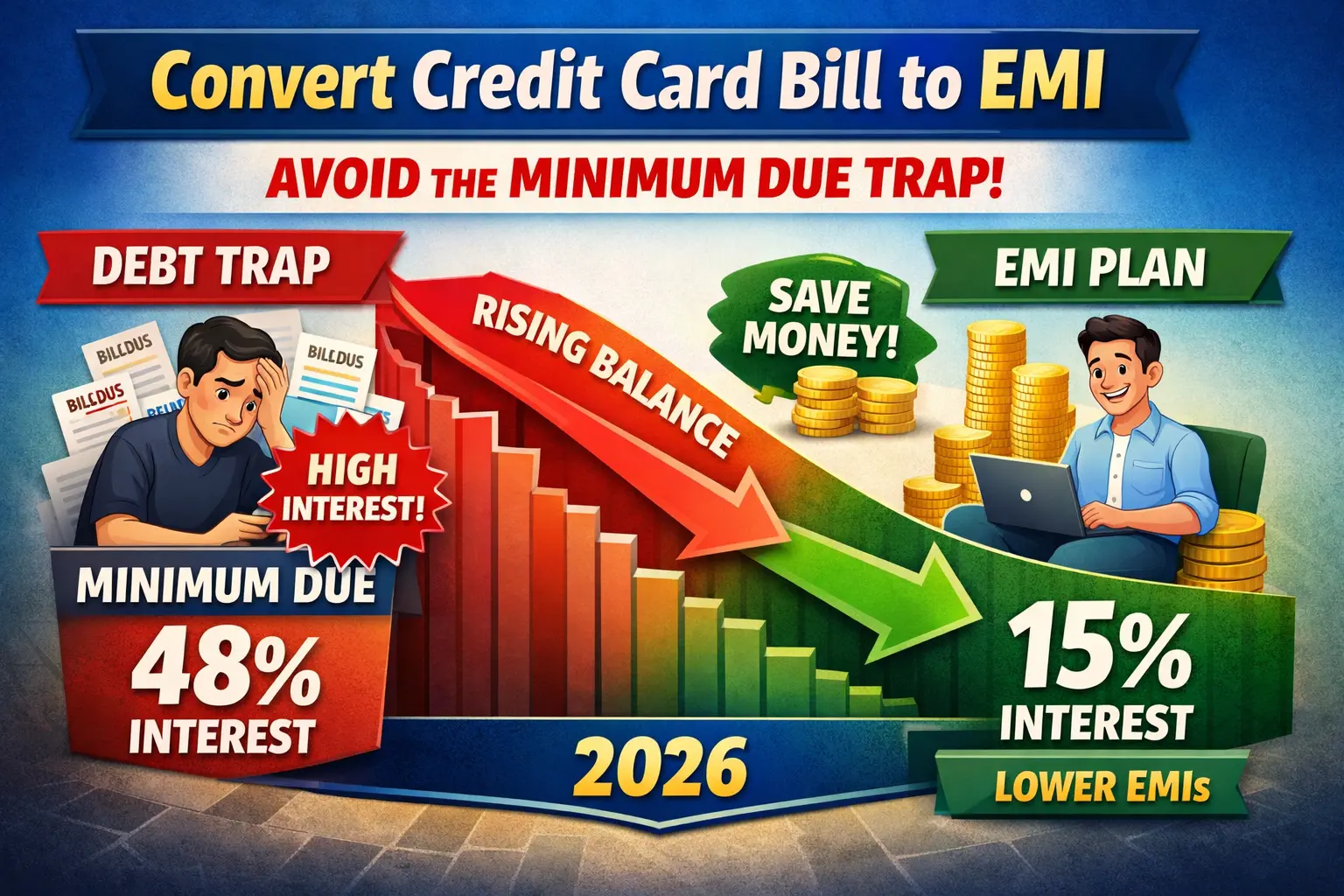
Convert Credit Card Bill into EMI is an important concept that every financial consumer should understand before accumulating high-interest revolving debt or defaulting on a billing cycle.
In the modern digital economy, reliance on unsecured credit lines is ubiquitous. Whether you are purchasing flagship electronics, managing emergency medical expenses, or even executing a massive online electricity bill payment, credit cards offer unparalleled convenience. However, this convenience harbors a lethal financial trap. When the 30-day billing cycle concludes and an exorbitant invoice is generated, banks aggressively market the "Minimum Amount Due" option. Consumers lacking liquidity often fall for this trap, unwittingly activating astronomical compounding interest rates.
In these critical scenarios, executing a structured conversion of your outstanding balance into Equated Monthly Installments (EMIs) is the most mathematically sound decision you can make. In this highly technical, humanized guide, we will deconstruct the mechanics of this conversion, analyze the exact Annual Percentage Rates (APR) involved, and demonstrate how this strategy safeguards your global credit score.
Table of Contents:
- 1. Convert Credit Card Bill into EMI: What Is the Difference?
- 2. The Mathematics of the 'Minimum Due' Trap
- 3. Step-by-Step API & Digital Conversion Protocol
- 4. Auditing the True Cost: Interest Rates & Hidden Fees
- 5. Strategic Impact on Your Credit Score (FICO/CIBIL)
- 6. Eradicating Fixed Costs to Free Up Capital
Convert Credit Card Bill into EMI: What Is the Difference?
When facing a liquidity crisis upon receiving your credit statement, you face a binary choice: pay the minimum due to keep the account active, or initiate a formal request to Convert Credit Card Bill into EMI. Understanding the mathematical difference between these two avenues dictates your financial survival.
Paying the "Minimum Due" (usually 5% of the total bill) transitions your account into "Revolving Debt." The bank immediately strips away your interest-free grace period and applies a punitive Annual Percentage Rate (APR) ranging from 36% to 48%, compounded daily on the outstanding principal. Conversely, converting the balance to an EMI structure freezes the debt. The bank issues a fixed-term amortization schedule (e.g., 12 months) at a significantly lower, fixed interest rate (typically 14% to 18%). This structured methodology prevents exponential debt growth and enforces disciplined capital repayment.
2. The Mathematics of the 'Minimum Due' Trap

The minimum payment trap is engineered by banking algorithms to maximize corporate profitability. Let us audit the mathematics:
Suppose your generated invoice is ₹100,000. The bank suggests a minimum payment of ₹5,000. You pay this, assuming you are safe. However, the remaining ₹95,000 immediately begins accruing daily compounding interest at 3.5% per month. Furthermore, any fresh transaction you execute the following month (even paying a utility bill) instantly incurs interest from day one. By continuously paying only the minimum, a ₹100,000 debt can take over 10 years to liquidate, costing you nearly triple the original principal in interest alone.
📊 Free Up Capital by Slashing Utility Bills!
Are high electricity bills draining the cash you need to clear your credit card debt? Discover how to crash your energy overheads to zero:
Utility Reduction Strategies Solar ROI Calculator3. Step-by-Step API & Digital Conversion Protocol
Global banking institutions have digitized this process, eliminating the need for physical branch visits. You can execute this conversion directly via your smartphone.
- Authenticate via Mobile API: Log into your bank's official mobile application or net-banking portal. Navigate to the 'Credit Cards' or 'Account Services' dashboard.
- Select the Target Transaction: You can either convert the entire unbilled outstanding amount or select specific high-value transactions (e.g., purchasing a 5-Star Inverter AC) exceeding ₹2,500. Click the "Convert to EMI" CTA.
- Determine Amortization Tenure: The algorithm will present multiple tenure options (3, 6, 9, 12, or 24 months). Shorter tenures incur higher monthly outflows but significantly lower total interest.
- Acknowledge and Execute: Review the final Terms and Conditions (T&C), specifically auditing the processing fee, and authorize the transaction via an OTP gateway.
4. Auditing the True Cost: Interest Rates & Hidden Fees
Converting to structured installments mitigates risk, but it is not a free service. You must audit the exact financial leakages involved in this operation:
| Financial Component | Standard Market Rate | Technical Description |
|---|---|---|
| Annual Percentage Rate (APR) | 14% to 18% per annum | The fixed interest applied to the reducing balance principal over your selected tenure. |
| Processing Fee | 1% to 2% of Principal | A one-time algorithmic charge levied in the immediate next billing cycle. |
| Government Taxation (GST) | 18% on Interest & Fees | Taxes are strictly levied on the interest component generated per month, not the principal. |
Is this financially viable? Absolutely. When juxtaposed against the catastrophic 48% APR of revolving credit card debt, accepting a 15% fixed rate with a predictable endpoint is the hallmark of intelligent financial management.
5. Strategic Impact on Your Credit Score (FICO/CIBIL)
A prevalent psychological barrier preventing consumers from initiating EMI conversions is the fear of downgrading their global credit score (CIBIL in India, FICO globally). This fear is fundamentally misplaced.
Allowing debt to revolve while paying minimums spikes your 'Credit Utilization Ratio', which algorithmic credit bureaus view as extreme financial distress, subsequently tanking your score. Conversely, converting the balance to an EMI is recognized as a proactive restructuring. As you successfully liquidate the monthly installments on time, the credit bureau logs a flawless "Positive Repayment History," which aggressively repairs and elevates your credit score over the long term.
Final Conclusion
In conclusion, executing a prompt decision to Convert Credit Card Bill into EMI is the ultimate defensive strategy against the predatory mathematics of compounding interest. The "Minimum Due" option is not a lifeline; it is a meticulously engineered debt trap. By leveraging your bank's digital portals, you can enforce a fixed-rate amortization schedule that aligns with your monthly liquidity. Furthermore, to ensure you consistently generate positive cash flow to clear these debts, actively identify and eliminate your fixed household overheads—such as transitioning to a decentralized Rooftop Solar System to permanently erase your utility bills.
Top 5 Frequently Asked Questions (FAQs)
- Can I convert my bill into EMI after the statement is generated? Yes, modern banking APIs permit post-generation conversion. However, you must execute the request at least 2 to 3 business days before the final Payment Due Date to prevent late fees.
- Am I permitted to foreclose the EMI before the tenure ends? Absolutely. If you secure sudden liquidity, you can request a foreclosure. Note that banks will levy a foreclosure penalty, typically ranging from 2% to 3% on the outstanding principal.
- Is the 'No-Cost EMI' aggressively marketed by e-commerce actually free? No. In a 'No-Cost' structure, the merchant pays the interest to the bank upfront as a subvention discount. However, as a consumer, you are still legally obligated to pay the 18% GST levied on that interest component.
- What happens if I default on an EMI installment? Bouncing an installment triggers immediate punitive late payment fees. More critically, the bank's automated systems will report the delinquency to credit bureaus, causing an instant, severe drop in your credit score.
- Can I convert the purchase of physical Gold or Jewelry into an EMI? No. Under strict directives from central banking authorities (such as the RBI in India), the conversion of gold bullion or jewelry purchases into credit card EMIs is explicitly prohibited to curb speculative trading.