
Net Metering vs Gross Metering 2026: Solar ROI & Cost Comparison Guide
Updated: March 2026 • Author: BijliBabu Team • Based on State Discom Tariff Regulations
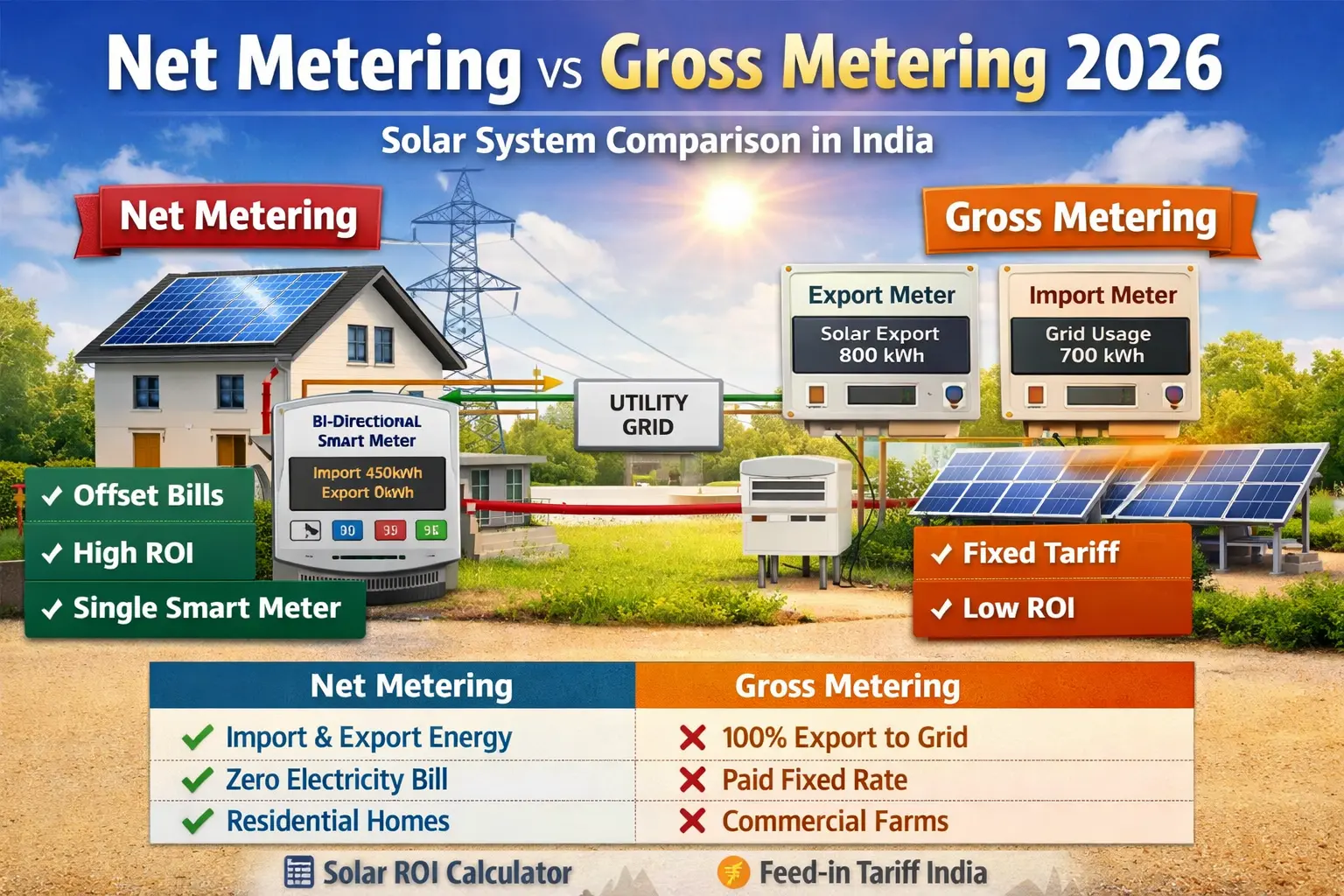
Net metering vs gross metering is an important concept that every electricity consumer should understand before installing a solar power system or smart meter infrastructure.
When engineering a grid-tied solar infrastructure for your property, deciding between these two frameworks is the most critical financial decision you will make. It dictates exactly how the utility company will interact with your generated power and fundamentally alters your Return on Investment (ROI).
Unfortunately, significant misinformation surrounds these terms in the renewable sector. Many commercial and residential consumers mistakenly select the wrong metering architecture. Consequently, instead of mitigating their energy overheads, they end up trapped in unfavorable utility agreements. In this deep-dive technical guide, we will deconstruct the specific electrical flow of both systems and enable you to strategically select the correct architecture for your facility.
Table of Contents:
Net Metering vs Gross Metering: What Is the Difference?
The core difference lies in how your generated solar energy is routed, measured, and compensated by the utility grid. When you deploy a solar array, it generates active power (kWh). However, generation curves rarely align perfectly with your consumption curves. You might produce maximum power at noon while you are at the office, leaving surplus energy unutilized.
Metering systems dictate how this excess energy is technically managed. They act as the accounting hardware between your localized solar plant and the broader municipal grid. Depending on the architecture chosen, you will either trade raw energy units to offset your bill or trade fiat currency at wholesale rates.
2. How Net Metering Architecture Functions

Net Metering utilizes a single, sophisticated 'Bi-directional Smart Meter'. This system is highly optimized for residential consumers seeking to eradicate their expensive utility bills entirely. To understand smart meter hardware, read our Smart Meter vs Traditional Meter analysis.
The Technical Workflow
Under this protocol, the solar inverter directly feeds your home's distribution panel first. If your appliances require 5kW, but your panels generate 8kW, the surplus 3kW is instantly exported to the state grid. The bi-directional meter logs this export. Conversely, at night, you import power from the grid.
At the conclusion of the billing cycle, the utility company calculates the 'Net' difference (Imports minus Exports). Therefore, if you export more than you import, your bill drops to zero. This mechanism forms the backbone of subsidies like the 300 Units Free Electricity Scheme.
📊 Calculate Your Net Metering ROI!
Do not guess your financial returns. Input your utility tariff into our algorithm to calculate your exact payback trajectory:
Solar ROI Calculator Utility Bill Calculator3. The Mechanics of Gross Metering
Gross Metering utilizes a completely different architectural logic. This setup requires two distinct, separate meters: a dedicated export meter and a standard import meter.
The Technical Workflow
In a Gross Metering setup, your localized solar plant is physically isolated from your home's internal wiring. 100% of the generated solar energy is pumped directly into the utility grid through the export meter. Meanwhile, your household imports 100% of its required electricity from the grid through the import meter.
Financially, the government pays you a fixed Feed-in Tariff (e.g., ₹3/unit) for all generated power. However, you must pay the standard retail tariff (e.g., ₹7/unit) for your home's consumption. Because retail tariffs are almost always higher than Feed-in Tariffs, this structure is generally unprofitable for standard residential setups.
4. Technical and Financial Comparison Matrix
To clarify the operational differences, review the following comparative analysis between the two architectures:
| Engineering Metric | Net Metering | Gross Metering |
|---|---|---|
| Primary Objective | Offsetting and neutralizing utility bills. | Generating a fixed monetary income stream. |
| Energy Routing | Local consumption first, surplus exported. | 100% exported directly to the grid. |
| Hardware Required | One Bi-directional Smart Meter. | Two Separate Meters (Import & Export). |
| Financial ROI | Extremely High (Offsets expensive retail power). | Low (Grid buys power at cheap wholesale rates). |
| Optimal Use Case | Residential rooftops & SME buildings. | Large-scale commercial solar farms. |
5. Regulatory Policies in India (2026 Updates)
The regulatory landscape strongly influences which system you can deploy. Under the current MNRE framework, residential consumers installing up to 10kW systems are legally entitled to demand Net Metering. State Discoms cannot refuse this request.
However, for commercial entities deploying capacities exceeding 10kW (or 500kW depending on state nuances), regulatory boards often mandate Gross Metering to manage grid load. To understand how industrial tariffs interface with these rules, audit our Commercial vs Domestic Electricity Rates documentation.
6. Strategic Conclusion: Which yields higher ROI?
In conclusion, when evaluating net metering vs gross metering, the strategic decision for residential consumers is unequivocally clear: You must demand Net Metering to achieve a viable ROI.
Net Metering allows you to substitute highly taxed, expensive utility power (often ₹8+ per unit) with your free solar energy, effectively reducing your bill to zero. Conversely, Gross Metering forces you to buy expensive power while selling your generated power at heavily discounted wholesale rates. Protect your financial assets by insisting on a bi-directional setup.
7. Top 5 Frequently Asked Questions (FAQs)
- Do I have to pay an installation fee for a bidirectional Net Meter? Yes, the regional Discom will levy a mandatory testing and installation fee, which is subsequently reflected in your first utility invoice.
- Does the government pay me if my net exports are positive at year-end? Yes. At the conclusion of the financial settlement period, if you maintain a net surplus, the Discom will credit your bank account at the pre-determined Feed-in Tariff rate.
- Can Gross Metering reduce my monthly consumption bill to zero? No. Under gross architecture, you are contractually obligated to pay the full retail cost for every unit your household consumes.
- Can an older mechanical meter function as a Net Meter? No. Legacy unidirectional meters lack the chipset required to measure reverse current flow. You must procure a certified bidirectional smart meter.
- What is the standard lead time for meter integration? Following the physical commissioning of the solar plant, bureaucratic processing and meter installation typically require 15 to 30 operational days.