
On grid vs off grid solar system 2026: Technical ROI Comparison
Updated: March 2026 • Author: BijliBabu Team • Based on Global Renewable Grid Protocols
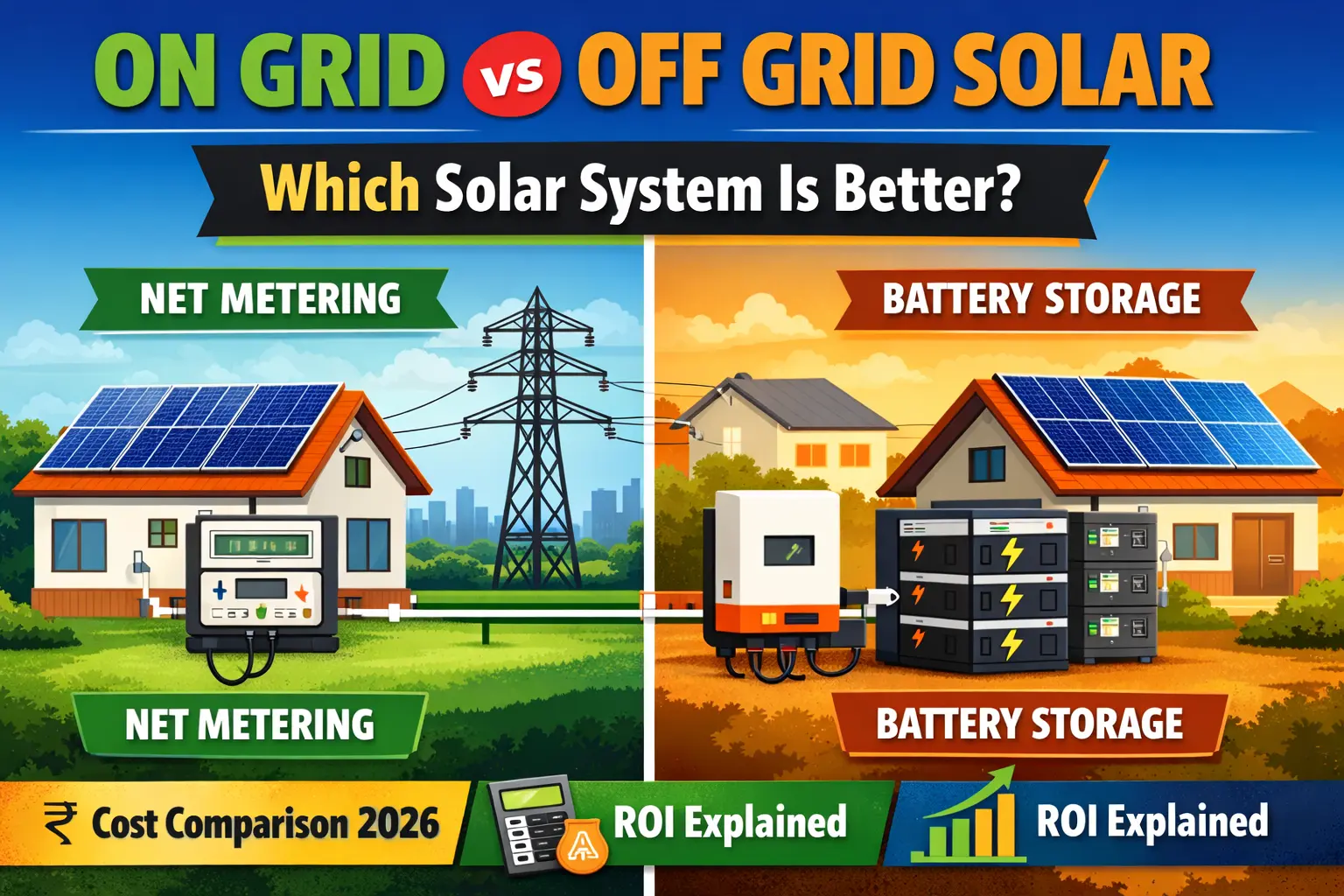
On grid vs off grid solar system is an important concept that every electricity consumer should understand before installing a solar power system or smart grid infrastructure.
With the rapid escalation of utility tariffs and the lucrative incentives offered by the PM Surya Ghar Yojna, millions are transitioning to solar power. However, a fundamental misunderstanding of system architectures often leads consumers to make disastrous financial investments. Many purchase expensive battery banks without realizing the long-term maintenance costs involved.
In this comprehensive technical guide, we will deconstruct the engineering mechanics of both architectures. Furthermore, we will analyze the exact financial Return on Investment (ROI) and explain why government subsidies strictly favor specific configurations over others.
Table of Contents:
On grid vs off grid solar system: What Is the Difference?
The primary architectural distinction lies in physical battery storage and utility synchronization. An on-grid system is physically tethered to the municipal utility grid and operates without localized battery storage. It utilizes the state grid as an infinite, virtual battery to store surplus power. Conversely, an off-grid system is a completely autonomous energy island. It requires a massive local battery bank to store energy for nighttime use, completely severing ties with the municipal grid. This structural difference drastically alters the Capital Expenditure (CAPEX) and regulatory subsidy eligibility.
2. The Engineering Behind On-Grid (Grid-Tied) Systems
During daylight hours, photovoltaic modules generate direct current (DC). The grid-tied inverter converts this to alternating current (AC) to power your household loads in real-time. Crucially, if your panels generate surplus energy, this excess power is exported back to the utility grid via a bidirectional 'Net Meter'. During the night, your home simply imports power back from the grid.
Because there is zero chemical storage involved, the operational maintenance is near zero. To review the hardware costs for this setup, examine our Solar Panel Price List 2026.
📊 Audit Your Consumption Before Deciding!
Do not guess your energy requirements. Input your raw utility data into our advanced algorithms to determine your exact required capacity:
Solar ROI Calculator Home Load Calculator3. The Mechanics of Off-Grid (Standalone) Systems

An Off-Grid system relies heavily on physical Energy Storage Systems (ESS), typically deep-cycle tubular or lithium-ion batteries.
During the day, the solar array powers the house while simultaneously charging the massive battery bank through a charge controller. Consequently, when the sun sets or a grid blackout occurs, the specialized off-grid inverter draws stored power from the batteries to sustain the household. To understand the inverter hardware required, read our Solar Inverter vs Normal Inverter breakdown. Because it requires high-capacity batteries, this architecture demands a significantly higher initial capital expenditure.
4. Technical & Financial Comparison Matrix (3kW Baseline)
Let us conduct a comparative audit using a standard 3kW residential system as our baseline metric.
| Engineering / Financial Metric | On-Grid (Grid-Tied) | Off-Grid (Standalone) |
|---|---|---|
| Government Subsidy Eligibility | Yes, up to ₹78,000 CFA. | No. Zero subsidy available. |
| Estimated Capital Expenditure | Approx. ₹1.5 Lakhs (Gross) | ₹2.5 Lakhs to ₹3.0 Lakhs |
| Blackout Response (Grid Failure) | System shuts down instantly. | Provides uninterrupted backup power. |
| Hardware Maintenance | Near zero operational maintenance. | High. Batteries require replacement. |
| Utility Bill Impact | Can achieve a net-zero bill. | Reduces bill, but incurs storage losses. |
5. The Subsidy Factor: Government Protocols
To incentivize renewable adoption, the central government has initiated massive Solar Subsidy programs. However, there is a critical caveat: Subsidies are exclusively disbursed for On-Grid installations.
The state aims to aggregate surplus residential power to stabilize the macro-grid. Therefore, if you isolate your home using a standalone battery system, you contribute nothing to the national grid. Consequently, you forfeit all rights to Central Financial Assistance (CFA). If you want to capitalize on the 300 Units Free Electricity Scheme, you must install an on-grid architecture. You can review exact state differences in our CFA vs State Solar Subsidy Difference guide.
6. Strategic Conclusion: Which yields higher ROI?
In conclusion, understanding the on grid vs off grid solar system debate dictates your financial success. From a purely financial perspective, the On-Grid Solar System is the undisputed champion for the vast majority of urban consumers. By utilizing the utility grid as an infinite, maintenance-free battery, and leveraging aggressive government subsidies, consumers achieve rapid ROI and permanent bill elimination.
Off-grid systems, while technologically impressive, suffer from high battery replacement costs (read our Lithium Ion vs Tubular Battery guide). They are niche solutions designed specifically for highly unstable or non-existent grid environments. Audit your local power reliability, calculate your capital, and invest strategically.
Top 5 Frequently Asked Questions (FAQs)
- Can I add batteries to an existing On-Grid inverter later? No. Standard grid-tied inverters lack the internal circuitry to regulate battery charging. You would need to entirely replace it with a Hybrid inverter.
- What exactly is a Hybrid Solar System? A hybrid architecture merges both technologies. It synchronizes with the grid for net metering but also features a localized battery bank for blackout emergencies. It is highly efficient but expensive.
- Why do On-Grid Solar Systems shut down during power cuts? In an On-Grid architecture, the inverter features 'Anti-Islanding Protection'. When the utility grid fails, the inverter shuts down to ensure your solar panels do not back-feed live current into dead grid lines, protecting utility workers.
- Can I get a loan for an off-grid system? While general personal loans are available, the highly subsidized, low-interest 'Solar Loans' provided by national banks are predominantly restricted to subsidized on-grid systems.
- Can an Off-Grid system sustain a heavy Air Conditioning load? Yes, but it requires a massive, high-amperage inverter (5kW+) and a substantial battery bank, inflating the capital cost exponentially.