Online Electricity Bill Payment 2026: Secure Transactions Across All States
Updated: March 2026 • Author: BijliBabu Team • Based on Digital Payment API Frameworks
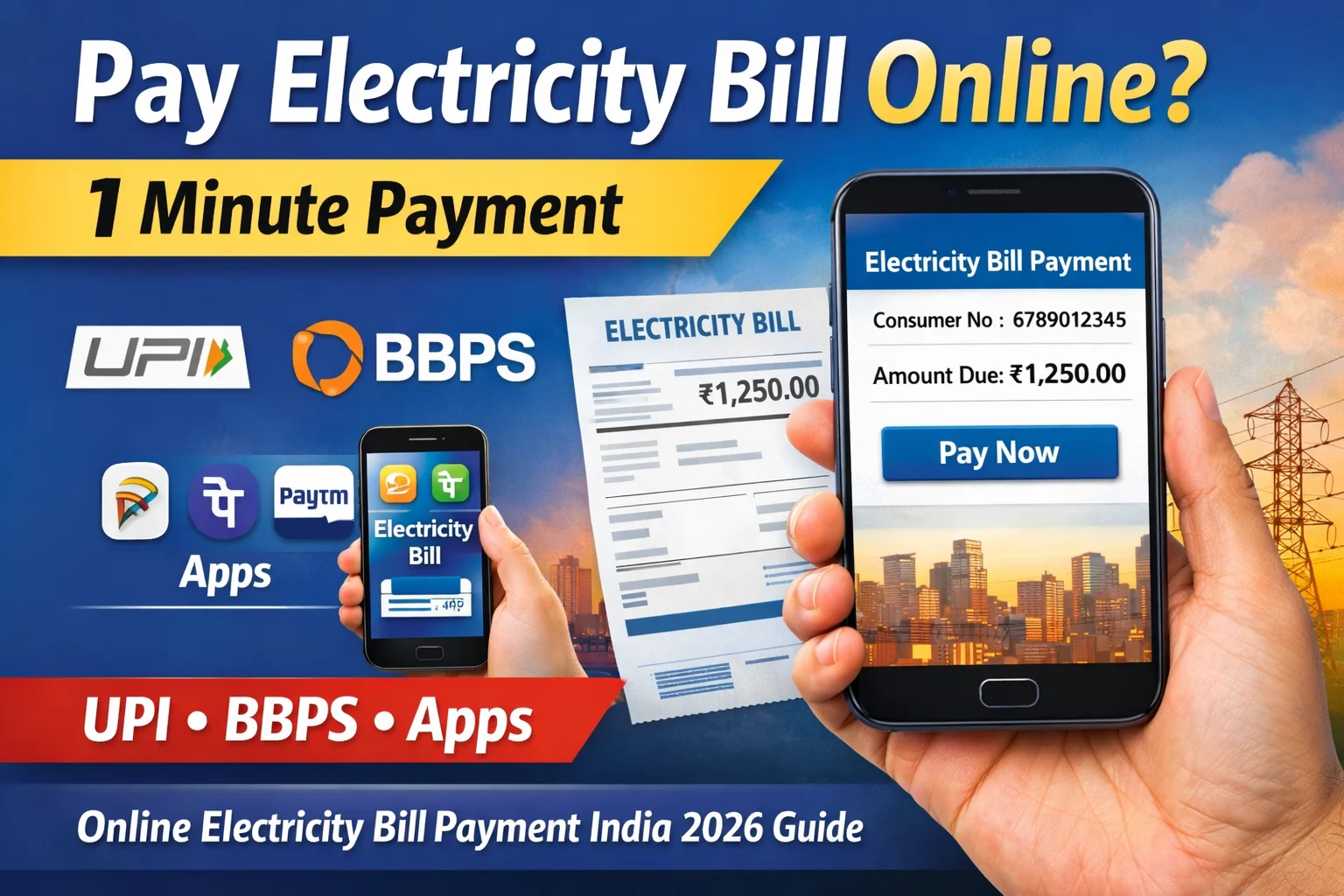
Online electricity bill payment is an important concept that every electricity consumer should understand before installing a solar power system or smart meter infrastructure in their residence.
The era of enduring grueling queues at local utility offices to physically hand over cash to a cashier is officially obsolete. In the rapidly digitizing global economy, whether you reside in the urban sprawl of Delhi or the coastal cities of Tamil Nadu, utility settlements have migrated entirely to robust API-driven ecosystems. This transition is further accelerated by the mass deployment of Advanced Metering Infrastructure (AMI), particularly prepaid smart meters, which absolutely mandate digital top-ups to maintain a continuous power supply.
However, navigating these digital gateways is not without risk. Consumers frequently face anxieties regarding data security, catastrophic failed transactions, and the looming threat of punitive Late Payment Surcharges (LPS). In this highly analytical, step-by-step guide, we will deconstruct the secure architecture of utility payments across all states. We will teach you how to automate your settlements, mitigate API failures, and financially benefit from your transactions.
Table of Contents:
- 1. Online electricity bill payment: What Is the Difference?
- 2. The Architecture of BBPS & Discom Integration
- 3. The 4 Most Secure Payment Topologies in 2026
- 4. Calculation Math: The True Cost of Legacy Payments
- 5. Case Study: Sarah’s Automation Prevents Disconnection
- 6. Troubleshooting Protocol for Failed Transactions
Online electricity bill payment: What Is the Difference?
To fully leverage digital infrastructure, you must recognize the structural difference between legacy manual accounting and modern API settlements. In the offline paradigm, consumers tendered cash or cheques, initiating a highly latent bureaucratic process. Discom ledgers required 48 to 72 hours to physically reconcile the payment. If your power was already severed due to a negative balance, you suffered days of darkness.
Conversely, online electricity bill payment operates on instantaneous, interoperable networks. When you execute a transaction via a payment gateway, the system pings the utility's Head-End System (HES) in milliseconds. For users with prepaid smart meters, the ledger updates instantly, triggering the meter's internal relay to close and restoring power within 10 to 30 seconds. It transforms a multi-day ordeal into a sub-minute, zero-friction automated protocol.
2. The Architecture of BBPS & Discom Integration
In India, this frictionless experience is powered by the Bharat Bill Payment System (BBPS), a centralized, interoperable infrastructure. Regardless of your geographical location, you simply search for your specific Distribution Company (Discom) on any certified platform. Here is a brief matrix of major integrated entities:
| State / Region | Primary Discom Entity (API Endpoints) |
|---|---|
| Uttar Pradesh (UP) | UPPCL (Urban / Rural), PVVNL, MVVNL, DVVNL |
| Maharashtra (MH) | MSEDCL (Mahavitaran), Adani Electricity, BEST |
| Delhi (NCR) | BSES Rajdhani, BSES Yamuna, Tata Power (TPDDL) |
| Rajasthan (RJ) | JDVVNL, JVVNL, AVVNL |
| Bihar | NBPDCL (North), SBPDCL (South) |
📊 Audit Your Bill Before Executing Payment!
Never pay an inflated invoice blindly. Utilize our advanced algorithms to verify your utility's exact slab rates and fixed charges:
Utility Tariff Calculator Smart Meter Burn Calculator3. The 4 Most Secure Payment Topologies in 2026
To mitigate the risk of phishing or data interception, you must utilize highly encrypted, official channels to execute your vends:
- Official Utility Applications: Downloading your Discom's official software (e.g., UPPCL Smart App) is the most secure and direct methodology. It entirely eliminates third-party platform fees.
- UPI & FinTech Aggregators: Platforms connected to the BBPS network (PhonePe, GPay) offer immense convenience. You simply input your unique Consumer Number to fetch live billing telemetry.
- Credit Card Structuring: For exorbitant summer invoices, executing the payment via a credit card is a strategic maneuver. It preserves immediate liquidity, and you can subsequently convert the credit card bill into an EMI to spread the financial impact.
- Auto-Pay (e-Mandates): Establishing a direct e-mandate on your banking account allows the system to autonomously debit the exact invoice amount 48 hours before the due date, guaranteeing zero late fees.
4. Calculation Math: The True Cost of Legacy Payments

Executing digital settlements is not merely a convenience; it is a measurable financial optimization strategy. Let us audit the hidden costs associated with manual payments via Calculation Math:
| Expense Variable | Legacy Offline Settlement | Digital API Settlement |
|---|---|---|
| Transit & Logistical Costs | ₹50 to ₹150 per month | ₹0 (Zero friction) |
| Late Payment Surcharge (LPS) | High risk (2% compounding penalty) | ₹0 (Executable at 11:59 PM on Due Date) |
| Cashback & Subvention Discounts | None | ₹20 to ₹100 via platform rewards |
| Annual Operational Savings | Zero | Approx. ₹1,500 to ₹2,500 Retained Capital |
If you wish to amplify these savings and permanently slash your energy consumption by up to 80%, review our comprehensive guide on Reducing Electricity Bills with Solar Energy.
5. Case Study: Sarah’s Automation Prevents Disconnection
The Incident: Sarah, a corporate professional in Delhi, frequently traveled for business. Relying on paper invoices, she missed her payment deadline by four days. The Discom levied a punitive ₹250 Late Payment Surcharge (LPS), and an automated disconnect order was issued for her meter.
The Strategic Pivot: Immediately following the incident, Sarah abandoned the legacy system. She registered her Consumer ID on a secure payment aggregator and established an active Auto-Pay mandate linked to her checking account.
The Result: Her utility invoices are now autonomously liquidated 72 hours prior to the due date. Not only did she permanently eradicate LPS penalties, but the utility also rewarded her with a 1% 'Prompt Payment Rebate' on her subsequent bills, generating pure passive income over the fiscal year.
6. Troubleshooting Protocol for Failed Transactions
The primary anxiety surrounding digital ecosystems is the dreaded "Failed Transaction"—where capital is debited from your bank, but the utility app reflects the invoice as unpaid. Do not panic; this is a standard API handshake error.
Under the rigid regulatory frameworks governing BBPS, orphaned capital cannot vanish. The system will automatically reconcile within 3 to 5 business days. The funds will either accurately reflect on the Discom's ledger or be completely refunded to your source account. Do not execute a duplicate payment immediately. If the timeline lapses without resolution, utilize your banking app to raise a 'Chargeback Dispute' or log a formal ticket via the Electricity Bill Correction Protocol.
Final Conclusion
In conclusion, executing an online electricity bill payment is the foundational step toward modernizing your household's financial operations. By leveraging robust APIs, establishing Auto-Pay mandates, and utilizing credit structuring for heavy summer invoices, you eliminate late fees, bypass bureaucratic queues, and secure absolute control over your utility ledger. Remember to conduct routine prepaid meter balance checks to monitor your daily burn rate. Ultimately, if you wish to eradicate this monthly billing cycle entirely, transitioning your property to a Grid-Tied Solar Infrastructure remains the most mathematically sound investment for the future.
Top 5 Frequently Asked Questions (FAQs)
- Do third-party applications (like Paytm) charge an extra fee for bill settlement? Yes. Many FinTech aggregators have recently introduced a 'Platform Convenience Fee' (ranging from ₹2 to ₹5) per transaction. To circumvent this, utilize the Discom's official application.
- Can I execute an online payment after the official Due Date has passed? Yes. The digital gateways remain open post-due date. However, the backend algorithm will automatically calculate and append the punitive Late Payment Surcharge (LPS) to the total payable amount.
- Am I permitted to pay my utility bill via a Credit Card and convert it to EMI? Absolutely. For high-value invoices (typically >₹2,500), paying via a credit card and utilizing the bank's portal to initiate an EMI conversion is an excellent liquidity management strategy.
- How long does it take for power to be restored after a digital prepaid recharge? If your power was severed due to a negative balance, the Head-End System (HES) processes the API receipt almost instantaneously. The meter's internal relay typically closes within 10 to 30 seconds, restoring the grid connection.
- Where can I locate my specific Consumer Account Number? Your unique 10 or 12-digit Consumer ID (Account Number) is permanently printed near the top of any previous physical or digital utility invoice. Note that rural and urban zone identifiers may differ slightly in length.