
Reduce electricity bill with smart meter 2026: Global Energy Savings Guide
Updated: March 2026 • Author: BijliBabu Team • Based on Global Energy Auditing Standards
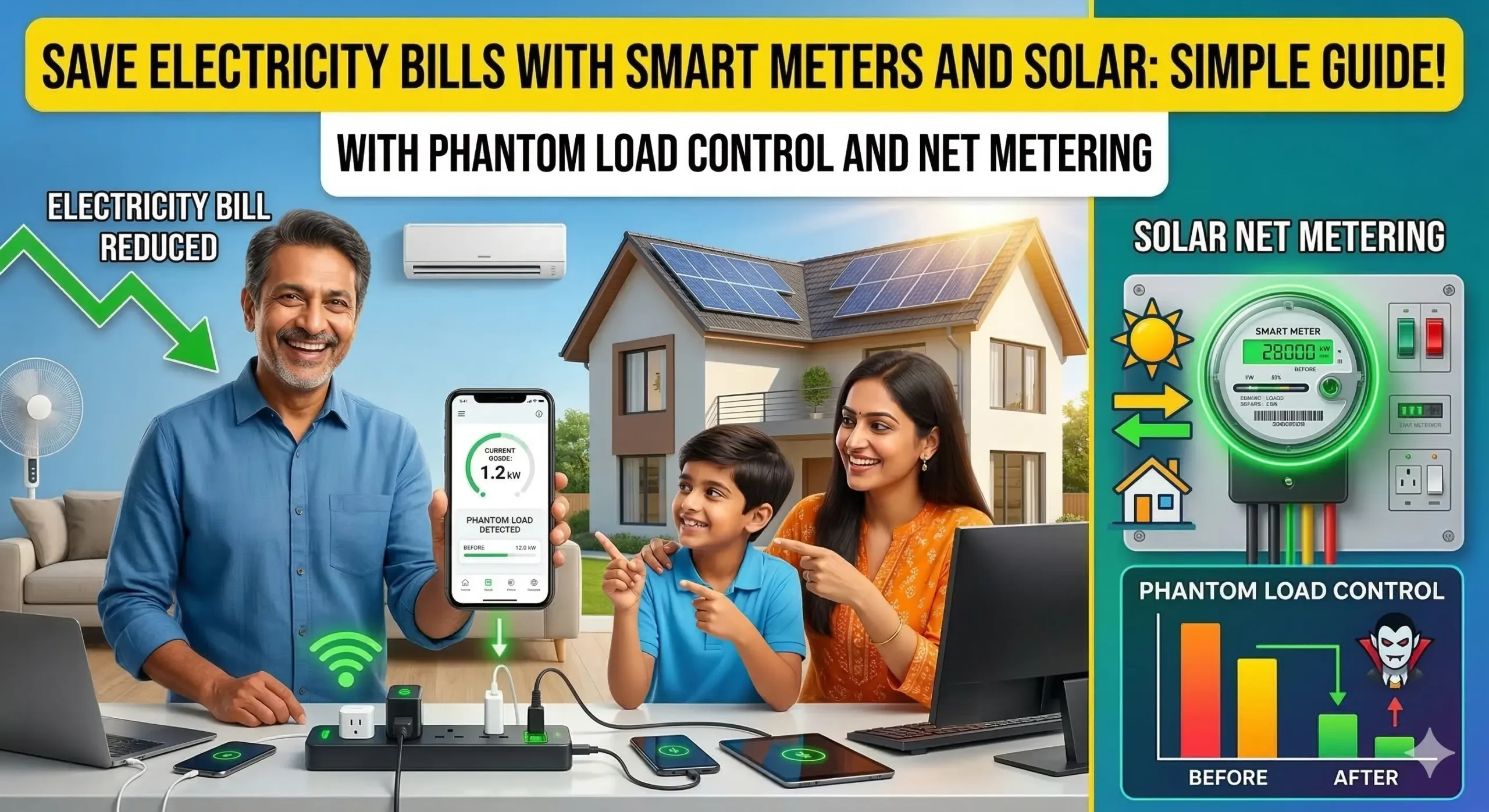
Reduce electricity bill with smart meter is an important concept that every electricity consumer should understand before installing a solar power system or smart meter infrastructure in their residence.
As utility companies globally phase out legacy mechanical meters in favor of digital Advanced Metering Infrastructure (AMI), consumers are experiencing a profound behavioral shift. Initially, the implementation of a smart meter often triggers "bill shock." Consumers frequently complain that their monthly utility invoices have inexplicably skyrocketed, leading to widespread anxiety regarding a potential smart meter negative balance.
However, a smart meter is not inherently designed to inflate your costs; it is an ultra-precise diagnostic tool. It strips away the inefficiencies of old analog meters and exposes exactly how your household consumes energy. In this highly technical, humanized guide, we will explore advanced strategies—from eradicating phantom loads to leveraging IoT automation—that will empower you to utilize your smart meter's telemetry to permanently slash your utility overheads by up to 30%.
Table of Contents:
- 1. Reduce electricity bill with smart meter: What Is the Difference?
- 2. Eradicating Phantom Loads (The Vampire Draw)
- 3. Mastering Time-of-Use (TOU) and Demand Penalties
- 4. Optimizing KVAh Billing via Power Factor Correction
- 5. Synergy with Smart Home Automation (IoT)
- 6. The Ultimate Solution: Solar Net-Metering Synergy
Reduce electricity bill with smart meter: What Is the Difference?
To fundamentally change your billing trajectory, you must understand the architectural difference between reactive and proactive energy management. Legacy analog meters fostered a reactive mindset. They were notoriously insensitive, often failing to register micro-loads (like a 2W mobile charger). Consumers remained completely blind to their consumption habits until the 30-day invoice arrived. For a deeper dive into hardware variances, read our Smart Meter vs Traditional Meter analysis.
Conversely, a smart meter demands proactive management. It is a highly sensitive metrology engine that captures 100% of the active load, logging data in 15-minute intervals. The key to reducing your bill lies in accessing this real-time telemetry via your utility's smartphone app. By observing your live consumption graphs, you can physically see the financial impact of leaving a television on standby, enabling immediate behavioral correction.
2. Eradicating Phantom Loads (The Vampire Draw)

Do you routinely switch off your television, set-top box, or HVAC system using only the infrared remote? In engineering terms, this is known as a 'Phantom Load' or 'Vampire Draw'.
While the screen is dark, the internal power supply unit (PSU) remains actively energized, waiting for a signal. A smart meter's digital chipset precisely registers this continuous 2W to 10W bleed. Across a household with multiple appliances, this 24/7 phantom load can artificially inflate your monthly bill by 10% to 15%. The Solution: Hard-disconnect appliances at the physical wall socket. If you suspect your meter is miscalibrated despite isolation, consult our Smart Meter Running Fast Troubleshooting Guide.
📊 Audit Your Consumption Algorithmically!
Before arguing with utility officials, calculate your exact sanctioned load and daily burn rate:
Smart Meter Burn Calculator Utility Tariff Calculator3. Mastering Time-of-Use (TOU) and Demand Penalties
A critical feature of smart meters is their ability to enforce dynamic pricing models, specifically Time-of-Use (TOU) tariffs and Maximum Demand (MD) penalties.
Maximum Demand Penalties: If your sanctioned contractual limit is 2kW, but you simultaneously operate heavy appliances (like an electric geyser and an AC) pushing your real-time draw to 3.5kW, the smart meter logs this violation. Utilities will subsequently apply a punitive multiplier on your fixed charges, obliterating your prepaid wallet. You must monitor your MD using the Smart Meter Push Button interface and shift heavy appliance usage to off-peak hours to flatten the curve.
4. Optimizing KVAh Billing via Power Factor Correction
Legacy mechanical meters primarily billed consumers on kWh (Active Power). However, modern AMI infrastructures utilize kVAh (Apparent Power) billing to account for grid inefficiencies.
If your residence utilizes obsolete, low-efficiency inductive loads (such as older ceiling fans or substandard water pumps), your electrical 'Power Factor' degrades. This means your appliances draw excess reactive power, creating stress on the grid. The smart meter penalizes this inefficiency, artificially inflating your bill by 10-15%. The Solution: Retrofit your home with 5-Star Inverter Appliances and BLDC technology, which feature internal power factor correction circuits.
5. Synergy with Smart Home Automation (IoT)
To truly master energy optimization, you must interface your smart meter data with active IoT hardware. By deploying retrofit Wi-Fi switches and smart plugs, you transition from manual to algorithmic energy control.
For instance, you can program an automated routine via your smartphone to shut down the HVAC compressor precisely at 4:00 AM, relying on ambient thermal mass and a low-power BLDC fan to maintain comfort until sunrise. This singular automation can slash your cooling overheads dramatically. For a complete hardware cost breakdown, review our Smart Home Automation Cost Guide.
6. The Ultimate Solution: Solar Net-Metering Synergy

While behavioral adjustments and IoT automation provide excellent marginal gains, the ultimate strategy to permanently eradicate utility overheads is deploying a decentralized PM Surya Ghar rooftop solar infrastructure.
When you commission a 2kW Grid-Tied Solar System, your smart meter undergoes a firmware update to facilitate bidirectional 'Net Metering'. During peak solar irradiance, the meter effectively runs "backward," logging exported surplus energy as financial credits. This physical generation entirely neutralizes your consumption algorithms, guaranteeing a zero-dollar energy bill for decades.
Final Conclusion
In conclusion, mastering how to reduce electricity bill with smart meter telemetry requires a shift from passive consumption to proactive energy management. Your smart meter is not an adversary; it is a highly accurate diagnostic dashboard. By physically eradicating phantom loads, respecting your Maximum Demand limits to avoid penalties, upgrading to high-power-factor appliances, and eventually integrating net metering solar architecture, you seize absolute control over your financial outflow. Embrace the data, optimize your infrastructure, and secure your energy independence.
Top 5 Frequently Asked Questions (FAQs)
- Does the meter deduct balance even when the main MCB is off? Yes. Discoms levy mandatory monthly Fixed Capacity Charges. The smart meter backend server deducts this prorated amount from your wallet every single night, even if consumption is zero.
- How can I audit my Maximum Demand (MD) to avoid penalties? You must physically cycle through the parameter menus using the meter's push button until the LCD displays the 'MD' metric in kilowatts. Ensure this never exceeds your sanctioned load.
- Does a smart meter run 30% faster than older analog models? No. It does not run "faster"; it is simply far more sensitive. It successfully registers micro-loads (like a 2W standby router) that the heavy mechanical discs of old meters failed to detect.
- What is Earth Leakage and how does it inflate my bill? If compromised wiring touches a damp wall, electricity bleeds into the earth. The smart meter detects this phase-to-neutral discrepancy and aggressively bills you for the leaked, wasted power.
- Can I legally slow down or hack the smart meter firmware? No. Any physical tampering or attempting to inject malicious code into the optical port is a severe criminal offense under the Electricity Act 2003, resulting in massive non-bailable fines and imprisonment.