
Smart Meter Emergency Credit 2026: Restore Power in 10 Seconds
Updated: March 2026 • Author: BijliBabu Team • Based on State Discom Relay Firmware Algorithms
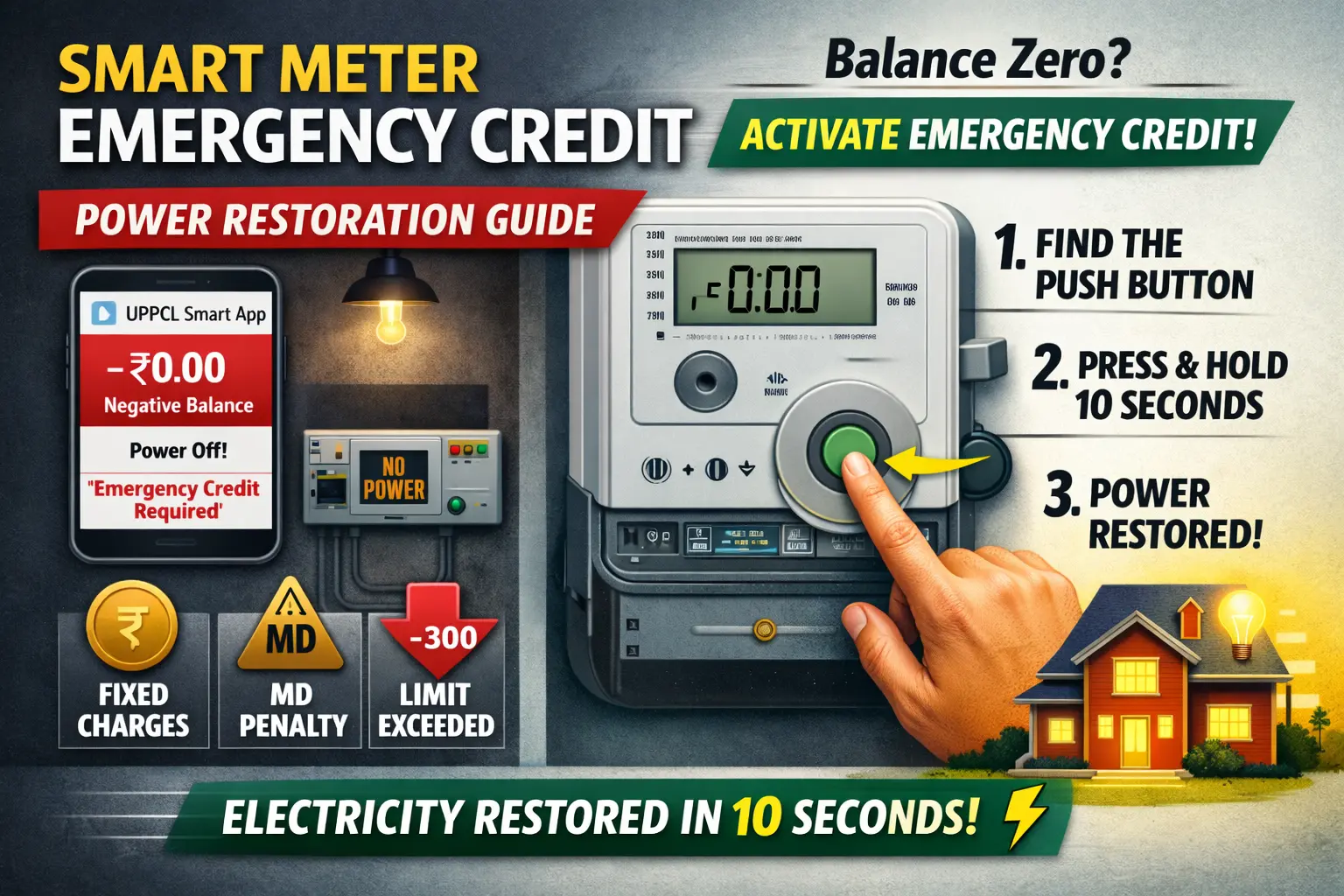
Smart meter emergency credit is an important concept that every electricity consumer should understand before installing a solar power system or smart meter infrastructure in their residence.
Imagine this scenario: It is 2:00 AM during a peak summer heatwave, and your home is suddenly plunged into darkness. You check your smartphone and realize that your prepaid utility balance has entirely depleted, triggering a negative balance disconnection. Attempting an online transaction via a payment gateway in the middle of the night can be severely hindered by banking maintenance downtimes. In this critical moment, you require a mechanism to restore your power instantly.
To mitigate this exact hazard, modern advanced metering infrastructure (AMI) is equipped with an emergency feature. In this highly technical guide, we will explore the precise engineering behind this fail-safe, demonstrate how to physically activate the relay switch, and explain the financial recovery algorithms executed during your subsequent recharge.
Table of Contents:
Smart Meter Emergency Credit: What Is the Difference?
To operate your smart metrology efficiently, you must understand the distinction between standard prepay funds and contingency funds. The primary difference is that a standard prepaid smart meter functions exactly like a mobile SIM card. It possesses two discrete ledgers: a 'Main Balance' funded via an online electricity bill payment, and a smart meter emergency credit ledger provided by the utility as an algorithmic fail-safe.
When your main balance hits ₹0, the metrology engine does not immediately trip the internal relay. It allows you to drift into a specified negative threshold (a warning phase). However, once this initial buffer is breached, the main contactor physically disconnects the power. At this juncture, you must manually initiate the emergency protocol to command the relay to close temporarily, restoring the flow of alternating current (AC) to your household.
2. How to Activate the Relay in 10 Seconds (SOP)

If your distribution panel is dead, bypass digital payment gateways and interface directly with the hardware. Follow this Standard Operating Procedure (SOP) using the meter's physical interface:
- Locate the Interface: Identify the small green or black push button located directly beneath the digital LCD screen on your meter enclosure. For a deeper understanding of the display parameters, read our Smart Meter Push Button Guide.
- Cycle the Menus: Press the button incrementally 3 to 4 times to cycle past the standard kWh and Maximum Demand (MD) screens.
- Execute a Long Press: When the LCD displays the parameter code "EC" (Emergency Credit) or simply "Credit", press and hold the button continuously for 5 to 10 seconds.
- Verify Relay Closure: Upon releasing the button, you will hear a distinct, loud mechanical 'clack'. This acoustic feedback confirms the internal contactor relay has closed.
- Power Restored: The flow of electricity to your load will resume instantaneously.
📊 Audit Your Daily Algorithmic Deductions!
Preempt power cuts by understanding your exact daily burn rate. Utilize our advanced diagnostic tools:
Smart Meter Burn Calculator Utility Bill Analytics3. What is the Financial Limit of the Credit?
The contingency funds are not infinite. The firmware is programmed to provide just enough capital to bridge the gap until the next business morning, allowing you to access a payment application or physical vendor.
| Geographical Zoning | Programmed Credit Threshold (INR) | Estimated Operational Uptime |
|---|---|---|
| Urban / Metropolitan Centers | ₹100 to ₹150 Cap | Approx. 12 to 15 Hours (Standard Load) |
| Rural / Agricultural Sectors | ₹50 to ₹100 Cap | Approx. 20 to 24 Hours (Low Load) |
4. Financial Recovery: The Next Recharge Algorithm
It is imperative to understand that the contingency power provided is a strict liability, not a grant. The utility's billing engine operates as a closed-loop system.
If you utilize ₹100 of the fail-safe buffer, your meter ledger will reflect a deficit of -₹100. During your subsequent recharge event (e.g., you deposit ₹500), the API will execute a priority recovery protocol. It will immediately claw back the ₹100 debt, leaving your active wallet with a net-positive balance of only ₹400. To prevent recurring trips, always inject sufficient capital to overcome the deficit and ensure a healthy positive buffer to maintain electricity safety.
5. Eradicating Grid Dependency (Strategic Fixes)
Managing prepaid micro-transactions and fighting negative balances is an exhausting operational overhead. The most strategic, permanent countermeasure is aggressively decentralizing your power generation.
By leveraging the massive capital injections offered via the PM Surya Ghar Registration, you can deploy a 2kW Grid-Tied Solar System. Through the mathematics of net metering, your daytime generation will offset your nocturnal consumption, effectively neutralizing your daily algorithmic burn rate and eliminating the threat of a tripped relay forever.
Final Conclusion
In conclusion, the smart meter emergency credit mechanism is a brilliant engineering fail-safe designed to protect consumers from the immediate hazards of a nocturnal blackout. By utilizing the physical hardware interface, you can override the relay and restore operations within seconds. However, this is strictly a stopgap measure. To achieve long-term stability, consistently monitor your active telemetry via the official consumer app, execute bulk recharges, or transition to subsidized rooftop solar infrastructure. If your billing metrics appear corrupted, initiate a bill correction application immediately.
Top 5 Frequently Asked Questions (FAQs)
- Can I activate the override function during the afternoon? No. The firmware typically restricts this function to "Friendly Hours" (between 8:00 PM and 10:00 AM) and Sundays. During business hours, a direct digital vend is mandatory.
- Why did the relay not close after I pressed the button? If you have entirely exhausted the programmed maximum credit threshold (e.g., utilizing all ₹150), the relay logic will refuse to close until fresh capital is injected into the ledger.
- Does the utility charge interest or penalties on this debt? No. The Discoms do not levy punitive interest or fines for utilizing the contingency feature. It operates strictly on a 1:1 financial recovery ratio during the next vend.
- My LCD does not display the 'EC' parameter code? Certain legacy variations of the smart hardware may utilize alternative hex codes for this function. Consult the OEM user manual specific to your meter's make and model.
- I recharged online successfully, but the relay is still open? Occasionally, GSM latency prevents the server from waking the meter. You must locate the 20-digit 'Token Number' on your digital receipt and manually punch it into the meter's keypad to force the update.