
Smart Meter Running Fast 2026: 7 Proven Ways to Reduce Your Bill
Updated: March 2026 • Author: BijliBabu Team • Based on Indian Electricity Act and CEA Guidelines
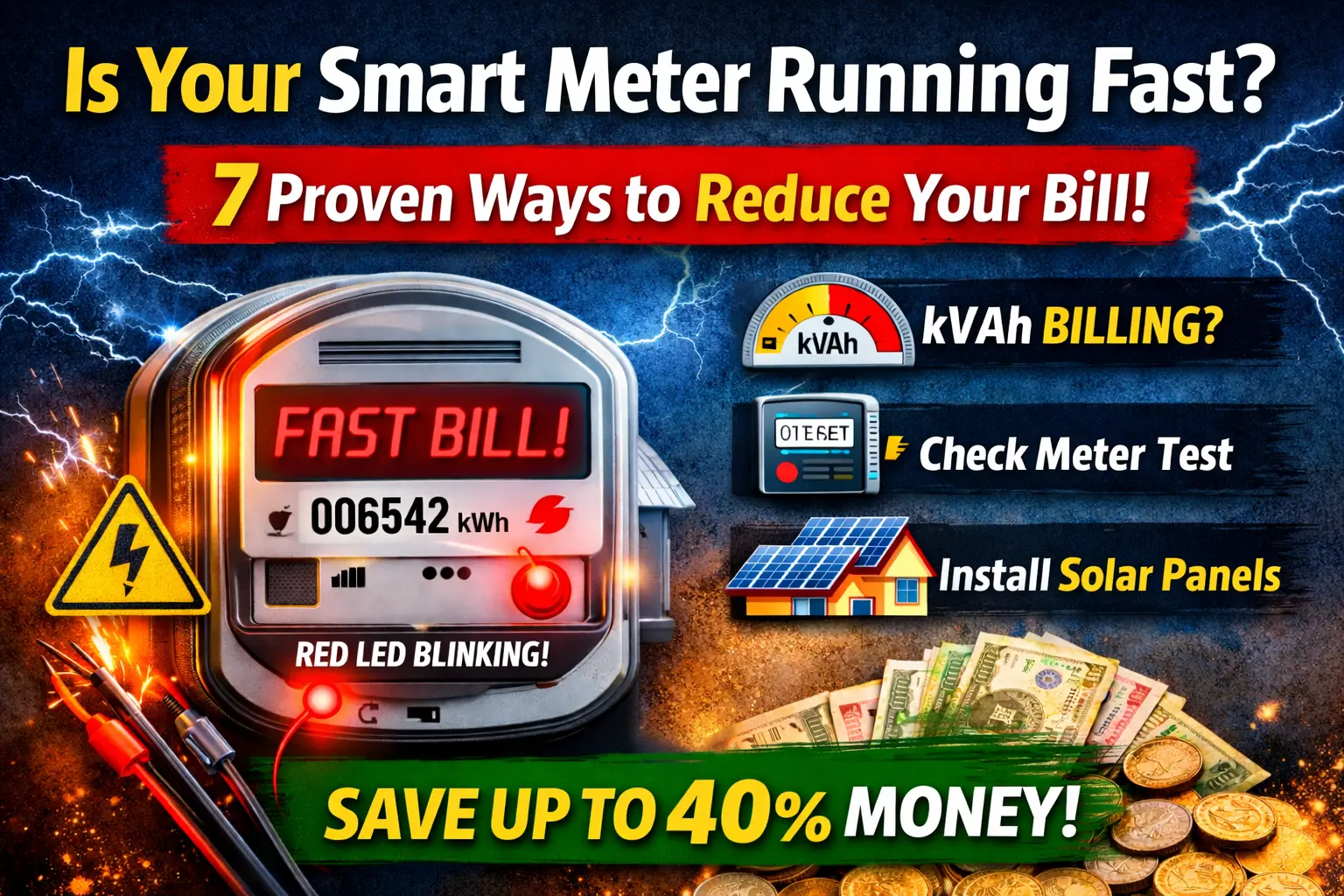
Smart meter running fast is an important concept that every electricity consumer should understand before installing a solar power system or smart meter infrastructure in their residence.
Across India, utility companies are aggressively phasing out legacy mechanical meters in favor of advanced digital smart meters. Almost immediately following this transition, millions of consumers echo the exact same grievance: "My electricity bill has inexplicably doubled, and my meter is jumping!" This frustration frequently leads to paranoia, with consumers suspecting that the utility provider has maliciously calibrated the firmware to overcharge them. This panic escalates rapidly when consumers confront a massive smart meter negative balance.
However, the engineering reality is vastly different. In 99% of audited cases, the metrology hardware is functioning flawlessly. The exorbitant bills are actually symptomatic of degraded internal wiring, severe earth leakages, and highly sensitive KVAh billing protocols. In this comprehensive guide, we will provide you with 7 highly technical, actionable methods to diagnose internal faults and drastically reduce your inflated utility invoices.
Table of Contents:
Smart meter running fast: What Is the Difference?
To diagnose the issue, you must understand the architectural difference between legacy mechanical (analog) meters and solid-state smart meters. Old meters relied on electromagnetic induction spinning an aluminum disc. They were notoriously insensitive. If you left a 5-Watt mobile charger or a small LED bulb running, the magnetic field wasn't strong enough to spin the heavy disc. Essentially, you consumed 'free' micro-power. For a deeper technical dive, read our Smart Meter vs Traditional Meter analysis.
Conversely, a smart meter acts as a highly sensitive metrology engine. If you leave your television on 'Standby Mode' using the remote (drawing merely 2 Watts), the smart meter's digital chipset precisely registers that current and bills you for it. Therefore, the meter is not "running fast"; it is simply capturing 100% of the active load that the previous meter ignored.
2. The Primary Culprit: Earth Leakage and Neutral Faults

The single largest contributor to inflated bills post-installation is internal 'Earth Leakage'. Over decades, the PVC insulation on concealed household wiring degrades. If an exposed live (phase) wire touches a damp wall or an iron conduit, electricity bleeds continuously into the earth.
Smart meters are equipped with highly sensitive Phase and Neutral current sensors. If the meter detects that 10 Amps entered the house via the Phase wire, but only 8 Amps returned via the Neutral wire (meaning 2 Amps leaked into the earth), it will aggressively bill you for the entire 10 Amps. To permanently halt this financial drain, you must deploy an RCCB, as detailed in our Earthing Installation Guide.
📊 Audit Your Consumption Algorithmically!
Before arguing with utility officials, calculate your exact sanctioned load and fixed charges:
Smart Meter Burn Calculator Bill Reduction Tips3. 7 Proven Technical Methods to Fix High Consumption
If you suspect severe overcharging, execute the following 7 diagnostic steps immediately:
- The MCB Isolation Test: Switch off your main Miniature Circuit Breaker (MCB) at night. Observe the smart meter. If the red 'Pulse LED' continues to blink rapidly, electricity is bypassing your meter (potential theft/tapping on your cable) or the meter firmware is corrupted.
- Eradicate Standby Power (Vampire Loads): Completely disconnect the physical wall sockets for televisions, microwaves, and set-top boxes. Standby mode drains significant active power over 720 hours a month.
- Install an RCCB: A Residual Current Circuit Breaker (RCCB) instantly trips the circuit if it detects even 30mA of earth leakage. This physically prevents the meter from logging wasted leakage power.
- Optimize Your Power Factor: Legacy inductive loads (old ceiling fans, sub-standard water pumps) destroy your Power Factor. Discoms now utilize KVAh billing. Replace these with high-efficiency BLDC fans or deploy localized capacitors.
- Audit Your Maximum Demand (MD): If your sanctioned load is 2kW, but you draw 3kW during peak hours, the Discom will levy a punitive 2X fixed charge penalty. Monitor your MD using the Smart Meter Push Button.
- Transition to Solar: The ultimate permanent fix is deploying a subsidized PM Surya Ghar rooftop solar system. Net metering physically forces the smart meter to run backward, neutralizing your bill.
- Execute a Megger Test: Hire a certified electrician to perform an insulation resistance test (Megger Test) on your household wiring to locate hidden phase-to-neutral shorts deep within the walls.
4. Protocol for Applying for an Official 'Check Meter'
If you have rigorously executed all 7 diagnostic steps, rectified your internal wiring, and the meter continues to register impossible consumption metrics, you must challenge the Discom legally.
The Bureaucratic Protocol: Submit a formal application to your Sub-Divisional Officer (SDO) requesting a "Check Meter Testing". You will be required to deposit a nominal testing fee (₹150 to ₹500). The utility will install a highly calibrated, certified parallel 'Check Meter' adjacent to your existing smart meter for 15 days. If the smart meter records an error margin exceeding the permissible ±2.5% threshold, the Discom is legally obligated to replace the hardware and credit your account for the erroneous billing. For procedural assistance, refer to our Wrong Electricity Bill Correction Application format.
Final Conclusion
In conclusion, a smart meter running fast is rarely an orchestrated scam or a hardware defect. These digital devices possess surgical precision and are merely exposing the extreme inefficiencies, standby power drains, and earth leakages hidden within your decades-old home wiring. By installing an RCCB, auditing your Maximum Demand, and understanding KVAh metrology, you can seamlessly regain control of your energy footprint. Stop battling the utility company; fix your internal infrastructure and watch your monthly invoice plummet.
Top 5 Frequently Asked Questions (FAQs)
- Does a smart meter run 30% faster than older analog models? No. It does not run "faster"; it is simply far more sensitive. It successfully registers micro-loads (like a 2W router) that the heavy mechanical discs of old meters completely failed to detect.
- Does the meter deduct balance even when the main MCB is off? Yes. Discoms levy mandatory monthly 'Fixed Capacity Charges'. The smart meter backend server deducts this prorated amount from your wallet every single night, even if consumption is zero.
- What is KVAh billing and why does it increase my bill? If your home operates low-efficiency inductive loads (old ceiling fans, un-serviced pumps), your Power Factor drops. Smart meters penalize this by billing you on Apparent Power (KVAh) rather than Active Power (kWh), inflating the cost.
- What does a continuously blinking Red LED on the meter mean? The red Pulse LED blinks proportional to the active load. If it blinks rapidly while all household switches are OFF, you are suffering from severe internal earth leakage or external electricity theft.
- Can I legally slow down or hack the smart meter firmware? No. Any physical tampering or attempting to inject malicious code into the optical port is a severe criminal offense under the Electricity Act 2003, resulting in massive non-bailable fines and imprisonment.