
Smart meter 100 200 500 1000 recharge calculation 2026: How Long Will It Last?
Updated: March 2026 • Author: BijliBabu Team • Based on AMI Prepayment Algorithms
Smart meter 100 200 500 1000 recharge calculation is an important concept that every electricity consumer should understand before installing a solar power system or smart meter infrastructure in their residence.
The global transition from postpaid mechanical meters to prepaid smart meters has fundamentally altered how households manage their utility finances. Instead of receiving a consolidated 30-day invoice, consumers are now responsible for funding a digital wallet, much like a prepaid cellular plan. Consequently, a massive wave of confusion has emerged. Consumers frequently execute small, habitual recharges (like ₹100 or ₹200), only to find their smart meter plunging into a negative balance within 48 hours, resulting in abrupt midnight blackouts.
This rapid depletion often leads consumers to falsely assume that their smart meter is running fast or overcharging them. However, the reality lies in the backend algorithms executing daily prorated deductions. If you do not mathematically understand how much of your ₹500 recharge is consumed by fixed taxes versus actual active power (kWh), you will remain trapped in a cycle of constant, frustrating micro-transactions. In this comprehensive technical guide, we will deconstruct the exact mathematical burn rate of your smart meter based on standard load capacities.
Table of Contents:
- 1. Smart meter 100 200 500 1000 recharge calculation: What Is the Difference?
- 2. The Base Burn Rate: Auditing Fixed Charges & Duties
- 3. ₹100 and ₹200 Recharges: The Micro-Vend Trap
- 4. ₹500 Recharge: The Middle-Class Baseline Analysis
- 5. ₹1000 Recharge: Sustaining Heavy Appliance Loads
- 6. Case Study: The Financial Penalty of Micro-Recharging
Smart meter 100 200 500 1000 recharge calculation: What Is the Difference?
You might assume that executing ten ₹100 recharges is mathematically equivalent to a single ₹1000 recharge. Under legacy systems, this was true. However, within the API architecture of modern smart meters, there is a profound operational difference. The difference lies in deficit recovery and relay logic.
When your meter drops into a negative balance and trips the physical contactor relay, the firmware requires a net-positive balance (>₹0.01) to restore power. If your deficit is -₹150 due to accumulated fixed charges, executing a ₹100 micro-vend will merely reduce the deficit to -₹50. The relay will remain open, and your home will remain dark. Conversely, mastering the Smart meter 100 200 500 1000 recharge calculation empowers you to execute a calculated lump-sum vend (e.g., ₹1000). This instantly clears all hidden algorithmic debts, triggers the emergency restore logic, and guarantees uninterrupted power for weeks without the stress of daily app monitoring.
2. The Base Burn Rate: Auditing Fixed Charges & Duties

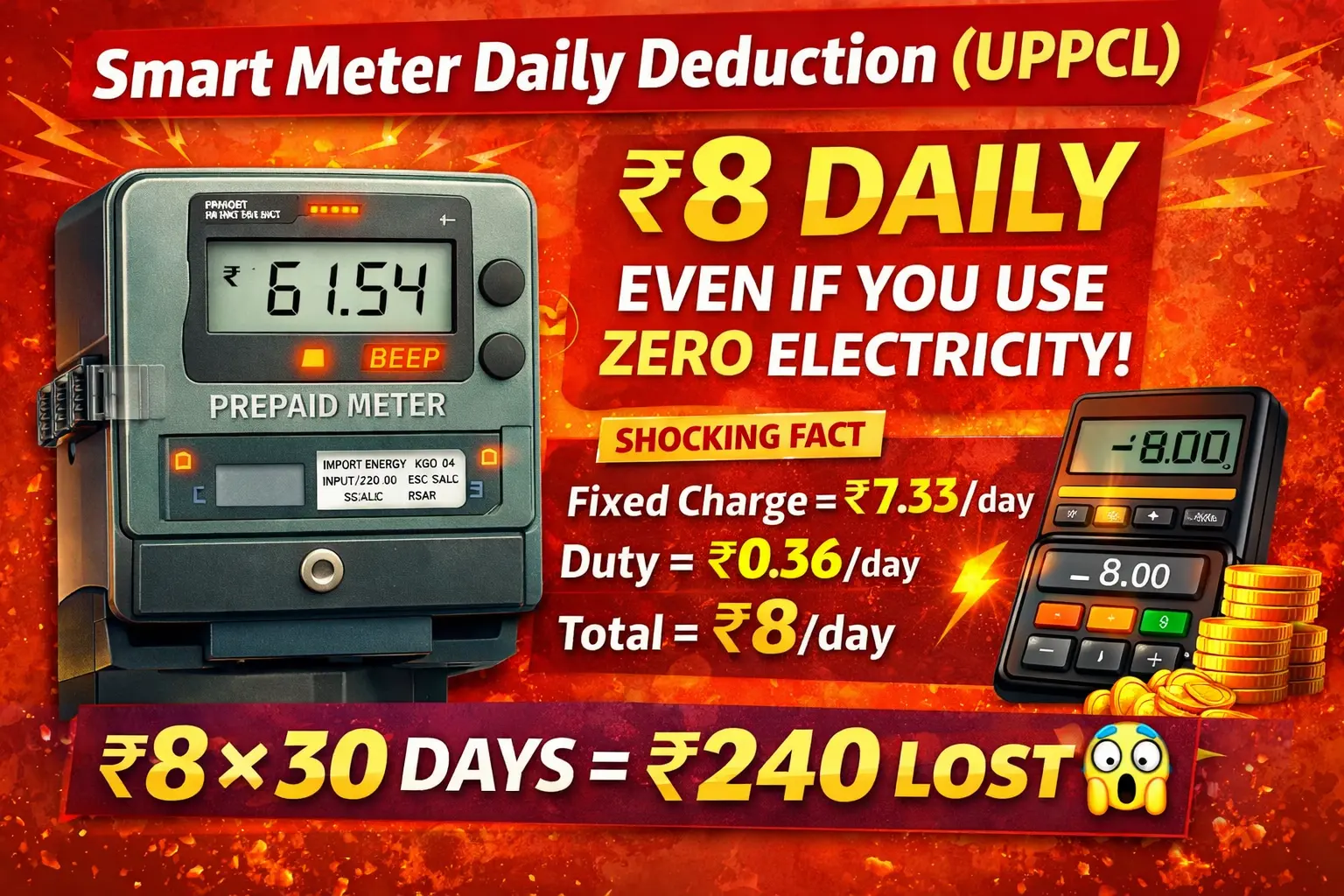
Before determining your optimal recharge tier, you must calculate your "Daily Baseline Burn Rate." Even if you disconnect your main MCB and consume absolute zero active power, the Head-End System (HES) will deduct money from your digital wallet every night at 00:00 hours. Assume a standard 2kW Sanctioned Load:
- Monthly Fixed Capacity Charge: 2kW x ₹110 = ₹220/month.
- Daily Prorated Fixed Charge: ₹220 ÷ 30 days = ₹7.33 per day.
- State Electricity Duty (5%): 5% of the fixed charge = ₹0.36 per day.
- Total Baseline Deduction: Approximately ₹8.00 per day (Zero consumption).
If you actively consume 4 units (kWh) during the day at an average tariff of ₹6.50/unit, your energy cost is ₹26. Therefore, your total daily algorithmic deduction is (₹8 Fixed + ₹26 Energy) = ₹34 per night. You can verify your specific state tariffs using our Smart Meter Deduction Calculator.
📊 Audit Your Consumption Algorithmically!
Before making an online payment, calculate your exact daily burn rate:
Negative Balance Calculator Utility Tariff Calculator3. ₹100 and ₹200 Recharges: The Micro-Vend Trap
Executing a ₹100 recharge is common among lower-income households, but the mathematics are brutal. Let us execute the calculation based on a 2kW load at ₹6.50/unit:
| Algorithmic Parameter | Calculation Math |
|---|---|
| Capital Injection (Vend) | ₹100.00 |
| Minus 2 Days Projected Fixed Charges | - ₹16.00 (Remaining Balance: ₹84.00) |
| Purchasing Power (Active Units) | ₹84 ÷ ₹6.50 = Approx. 13 Units |
| Operational Uptime | Consuming 4 units/day = Depleted in 3 Days! |
Warning: If your meter has already drifted into a negative balance (e.g., -₹50), a ₹100 vend leaves you with only ₹50 of usable capital. This will exhaust in less than 48 hours. To understand how to read these metrics, consult our Smart Meter Push Button Guide.
4. ₹500 Recharge: The Middle-Class Baseline Analysis
The ₹500 tier is the strategic minimum for a standard household operating without heavy inductive loads (like Air Conditioners). Here is the telemetry breakdown:
- 15 Days Projected Fixed Charges = ₹120 (Remaining Balance: ₹380).
- Purchasing Power = ₹380 ÷ ₹6.50 = Approx. 58 Units.
- Assuming a conservative daily burn rate of 3.5 units (ceiling fans, LED lighting, inverter refrigerator), a ₹500 capital injection will comfortably sustain operations for 15 to 16 days.
5. ₹1000 Recharge: Sustaining Heavy Appliance Loads
During peak summer heatwaves, activating a 1-Ton 5-Star Inverter AC alongside standard appliances pushes your daily burn rate to 10-12 units. In this scenario, micro-vends are a severe operational liability.
- 30 Days Projected Fixed Charges = ₹240 (Remaining Balance: ₹760).
- Purchasing Power = ₹760 ÷ ₹6.50 = Approx. 116 Units.
- At a heavy burn rate of 10 units/day, a ₹1000 vend will be entirely exhausted in 10 to 12 days.
If executing multiple ₹1000 recharges monthly is destroying your financial liquidity, the ultimate strategic countermeasure is deploying a decentralized 2kW Solar System via the PM Surya Ghar scheme. Bidirectional net metering will permanently crash your daily burn rate to zero.
6. Case Study: The Financial Penalty of Micro-Recharging
The Incident: David, an urban consumer, utilized a third-party FinTech aggregator to execute ₹100 micro-vends every single day. Due to server latency during a midnight API handshake, a payment failed. His meter tripped, plunging his home into darkness.
The Strategic Fix: Following our online payment optimization guide, David consolidated his strategy. Instead of thirty ₹100 micro-vends, he executed a single, automated ₹3000 lump-sum payment on the 1st of the month.
The ROI: By abandoning micro-vends, David avoided the FinTech aggregator's "Platform Convenience Fee" (₹3 per transaction), instantly saving ₹90 monthly. Furthermore, his account maintained a permanent positive buffer, entirely eradicating the threat of Maximum Demand (MD) penalties pushing him into a negative deficit.
Final Conclusion
In conclusion, mastering the Smart meter 100 200 500 1000 recharge calculation transforms you from a reactive consumer into a strategic energy auditor. Smart meter firmware operates on unforgiving mathematical algorithms; it blindly deducts fixed capacity charges every night regardless of your active usage. Executing ₹100 micro-recharges is an inefficient, high-risk strategy that leaves you vulnerable to sudden blackouts and unrecoverable negative deficits. Always audit your historical daily burn rate via the official utility app, calculate your required buffer, and execute consolidated lump-sum vends. Ultimately, to permanently divorce yourself from the stress of prepaid metering, leveraging government subsidies to install rooftop solar panels remains the most financially intelligent decision for the next 25 years.
Top 5 Frequently Asked Questions (FAQs)
- Does the meter deduct balance even when the main MCB is switched off? Yes. Discoms levy mandatory monthly Fixed Capacity Charges (e.g., ₹110/kW). The smart meter backend server deducts this prorated amount from your wallet every single night, even if consumption is zero.
- I recharged ₹500, why is my power still disconnected? If your prior deficit was -₹600, your ₹500 injection only elevates the balance to -₹100. The internal relay requires a net-positive balance (>₹0.01) to restore the physical connection.
- Do third-party applications (like Paytm/PhonePe) charge an extra fee for recharging? Yes. Many FinTech aggregators have recently introduced a 'Platform Convenience Fee' (ranging from ₹2 to ₹5) per transaction. To circumvent this, utilize the Discom's official application.
- Why does my recharge deplete faster when I trigger an MD Penalty? If your real-time active load exceeds your official Sanctioned Load, the metrology engine flags an MD violation. The utility server subsequently applies a 2X punitive multiplier on your fixed charges, doubling your daily baseline burn rate.
- What should I do if my recharge fails but funds are debited from my bank? Do not execute a duplicate payment immediately. Under BBPS protocols, orphaned capital will automatically reconcile within 3 to 5 business days, either updating your meter ledger or refunding to your source account.