
Solar Panel Cleaning Guide 2026: Maximize Your Solar ROI
Updated: March 2026 • Author: BijliBabu Team • Based on Tier-1 OEM Warranties
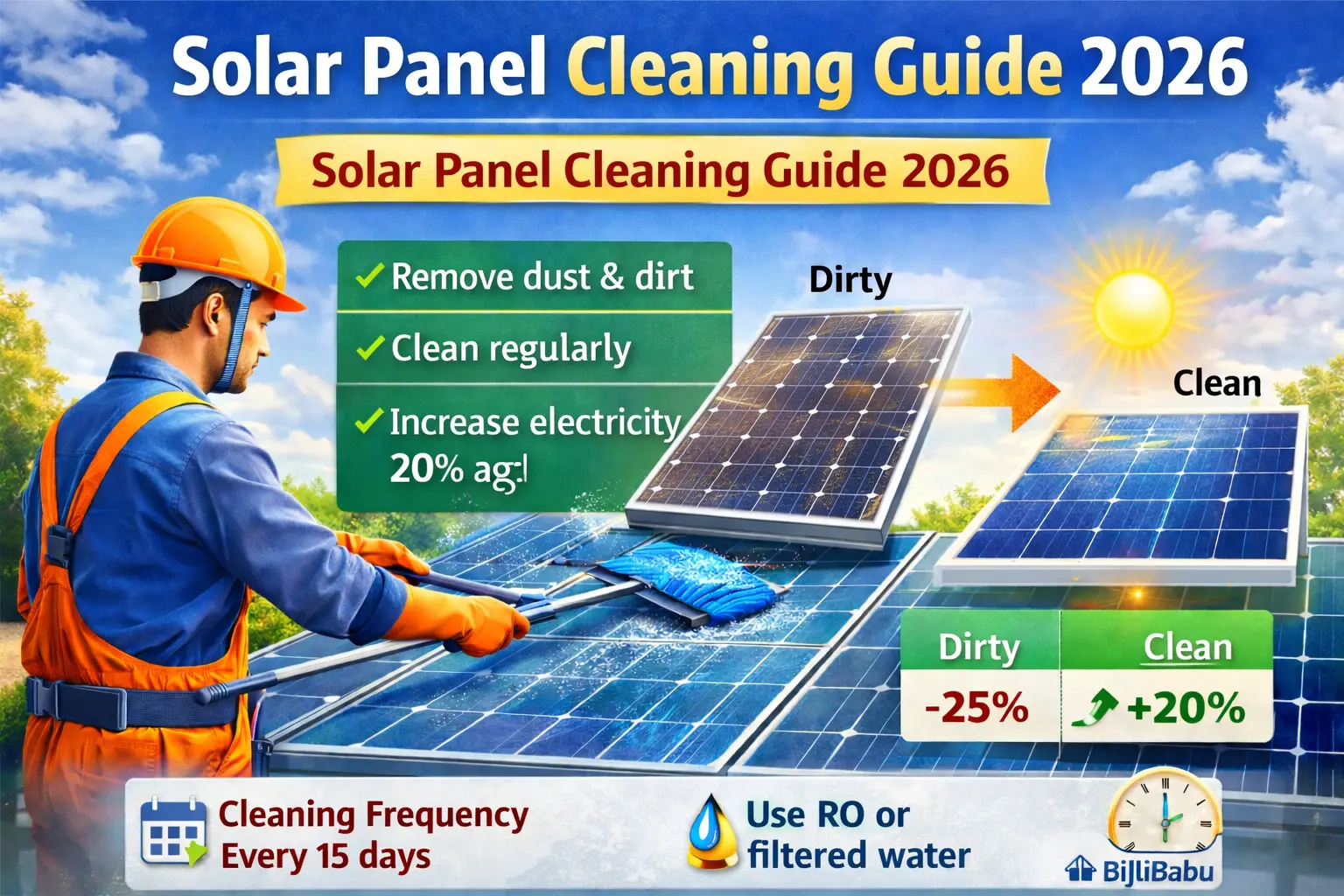
Solar panel cleaning guide is an important concept that every electricity consumer should understand before installing a solar power system or smart grid infrastructure on their property.
Transitioning to renewable energy via schemes like the PM Surya Ghar Yojna requires significant capital expenditure. Initially, your brand-new solar array will generate peak energy yields. However, after a few months, many homeowners notice a disturbing drop in daily power generation. They often misdiagnose this drop as a catastrophic hardware failure or a faulty inverter.
In 90% of cases, the hardware is functioning perfectly. The true culprit is 'Soiling Loss'. The accumulation of dust, smog, and biological matter creates a physical barrier over the tempered glass. Consequently, this barrier prevents photons from reaching the internal silicon cells. In this technical guide, we will explore the precise mechanics of soiling loss and highlight catastrophic cleaning mistakes that can instantly void your lucrative 25-year warranty.
Table of Contents:
- 1. Solar Panel Cleaning Guide: What Is the Difference? (Manual vs Automated)
- 2. The Physics of Soiling Loss and Efficiency Drop
- 3. Optimal Cleaning Frequency Matrix
- 4. The Thermal Shock Hazard (When NOT to Clean)
- 5. Navigating Hard Water Issues (Calcification)
- 6. Technical Standard Operating Procedure (SOP)
Solar Panel Cleaning Guide: What Is the Difference? (Manual vs Automated)
When engineering an Operations and Maintenance (O&M) strategy for your solar array, you must understand the difference between Manual Cleaning and Automated Robotic Cleaning.
Manual cleaning utilizes telescopic microfiber mops and human labor. It is highly cost-effective and perfectly suited for residential setups like a standard 2kW Solar System. Conversely, automated cleaning involves deploying expensive, waterless robotic brushes that traverse the panels daily. While robots are essential for massive 500kW commercial farms to mitigate labor costs, they represent an unnecessary, unrecoverable capital expense for a typical homeowner.
2. The Physics of Soiling Loss and Efficiency Drop

Photovoltaic panels operate by absorbing photons from sunlight. When a layer of particulate matter (such as construction dust, pollen, or bird droppings) coats the anti-reflective glass, it acts as a severe shading element. This physical phenomenon is technically termed 'Soiling Loss'.
For context, if you deployed a premium 5kW Solar System, it is engineered to produce roughly 25 units (kWh) daily. However, heavy soiling can easily reduce this daily output to 18 units. Over a month, this equates to a staggering loss of over 200 units of active power. Therefore, to truly Reduce Electricity Bill with Solar Energy, establishing a strict, scheduled cleaning protocol is absolutely mandatory.
📊 Calculate Your Financial Losses Due to Dust!
Are you losing money every day because of dirty panels? Input your tariff data into our algorithms to calculate your exact ROI depreciation:
Solar ROI Calculator Utility Bill Calculator3. Optimal Cleaning Frequency Matrix
There is no universal standard for cleaning intervals. The necessary frequency is heavily dictated by your localized micro-climate and geographic positioning. Refer to the operational matrix below:
| Geographic / Climatic Condition | Recommended Cleaning Frequency |
|---|---|
| Dry Summers / High Dust Zones | Once every 10 to 15 days |
| Winter / Moderate Zones | Once every 20 to 25 days |
| Heavy Monsoon Seasons | Zero (Heavy rain performs natural cleansing) |
| Industrial / Agricultural Belts | Weekly (Due to heavy particulate smog and crop dust) |
Rather than guessing, you should rely on data telemetry. If you utilize an On Grid vs Off Grid Solar System, monitor your inverter's Wi-Fi application. If you observe a sustained 10% to 15% drop in peak generation on a perfectly sunny day, it is time to deploy your physical cleaning protocol.
4. The Thermal Shock Hazard (When NOT to Clean)
The most catastrophic error consumers make is cleaning their panels during peak solar noon. Under direct ambient sunlight, the tempered glass surface of a solar module can easily reach temperatures exceeding 65°C (150°F).
If you apply ambient or cold water to this superheated glass, it induces a severe thermodynamic reaction known as 'Thermal Shock'. This causes the tempered glass to instantaneously shatter into thousands of micro-fragments. Consequently, your panel is irrevocably destroyed, and this specific negligence completely voids OEM warranties. You would need secondary Solar Panel Insurance Cost to cover such damages.
5. Navigating Hard Water Issues (Calcification)
In many regions across India, municipal or borewell water possesses extremely high TDS (Total Dissolved Solids), commonly referred to as 'Hard Water'.
If you repeatedly wash your premium Monocrystalline Panels with hard water, the sun will rapidly evaporate the moisture, leaving behind stubborn calcium and magnesium mineral deposits. Over time, this creates an opaque white crust (Calcification) on the glass. This crust blocks sunlight permanently and is nearly impossible to scrub off without deeply scratching the panel. Always utilize filtered or relatively soft water for maintenance operations.
6. Technical Standard Operating Procedure (SOP)
Solar hardware is robust against high-velocity wind but highly sensitive to abrasive forces. Follow this technical Standard Operating Procedure to protect your assets:
- Electrical Isolation: Ensure absolute Electricity Safety. Manually disconnect the DC isolator switch near the inverter before commencing any wet work to prevent arcing.
- Dry Brushing: Utilize a soft, dry microfiber mop to gently sweep away loose, abrasive dust particles first.
- Low-Pressure Washing: Use a standard garden hose to rinse the modules. Strictly avoid high-pressure power washers, as they can breach the module's waterproof silicon edge seals.
- Chemical Avoidance: Never utilize harsh industrial detergents or abrasive soaps. These chemicals will permanently strip the vital Anti-Reflective Coating (ARC) from the glass. Pure, soft water is sufficient.
Final Conclusion
In conclusion, adhering strictly to this solar panel cleaning guide ensures that your hardware will operate at peak efficiency for its entire 25-year lifecycle. Allowing soiling loss to accumulate is akin to throwing money away. By establishing a rigorous bi-weekly cleaning protocol utilizing only soft water and microfiber tools during cool ambient temperatures, you can instantly recapture up to 20% of your lost power generation. Treat your hardware with engineering respect, avoid thermal shock, and your system will continue to generate maximum ROI for decades.
Top 5 Frequently Asked Questions (FAQs)
- Should I clean my panels during the monsoon season? No. Heavy rain acts as an excellent, natural solvent. It will effortlessly wash away accumulated dust and debris without any manual intervention.
- Can I walk or stand on the solar panels to clean them? Absolutely never. Subjecting the tempered glass to the concentrated weight of a human causes invisible 'micro-cracks' in the silicon cells, permanently destroying output.
- Must I shut down the solar inverter during cleaning? Yes. To entirely eliminate the risk of electrical arcing or short-circuits, it is highly recommended to isolate the Solar Inverter via the DC isolator switch.
- Are automated robotic cleaners a viable option? Automated dry-brushing robots are excellent for massive utility-scale commercial farms. However, their high capital cost makes them financially unviable for standard residential rooftops.
- Can I use dish soap to clean the glass? No. You must avoid harsh chemical detergents. They leave a film residue and can strip away the Anti-Reflective Coating (ARC) engineered into the glass.