
Solar Panel Lifespan & Degradation 2026: Maximize Output & ROI
Updated: March 2026 • Author: BijliBabu Team • Based on Tier-1 OEM Linear Warranty Specifications
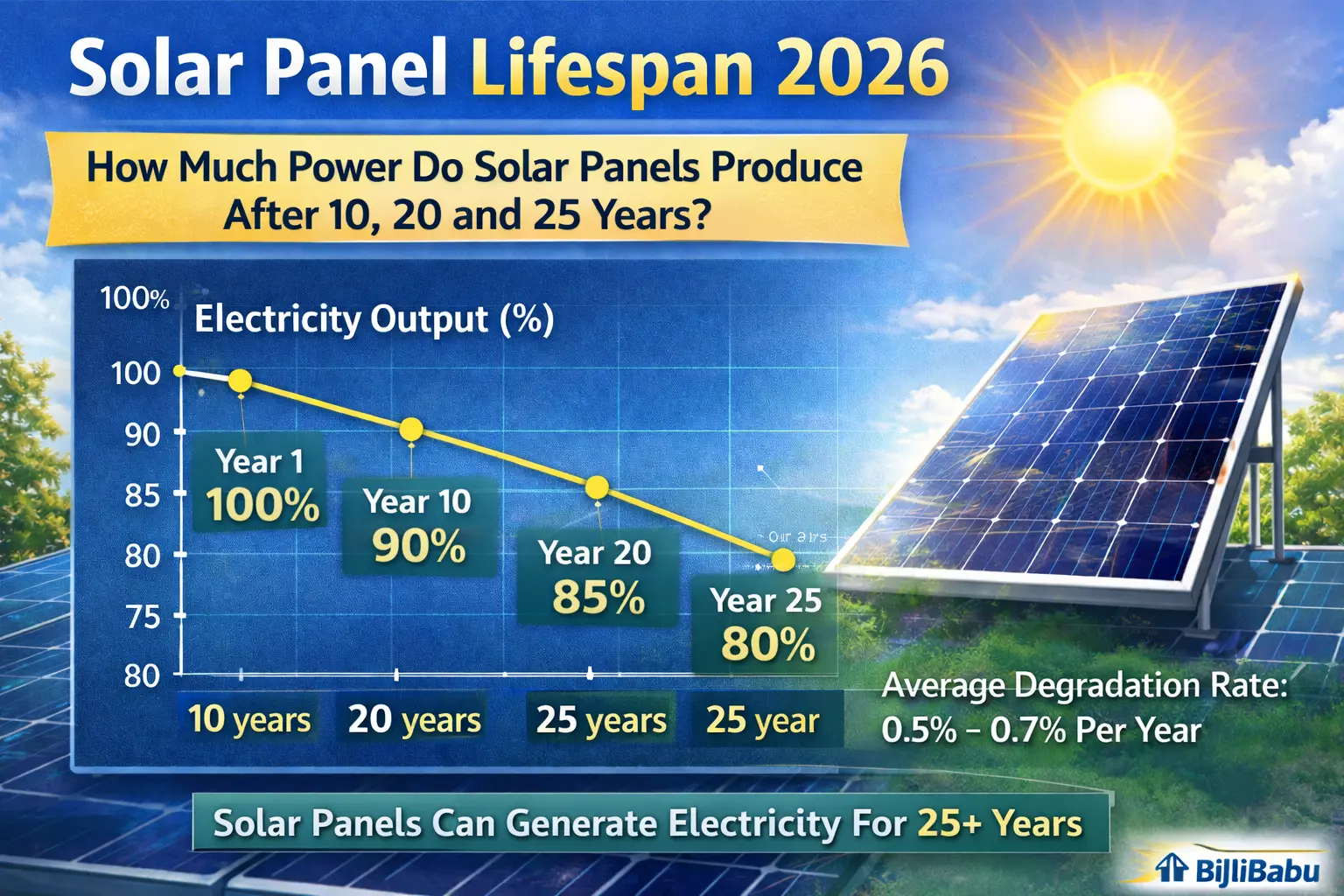
Solar panel lifespan and degradation is an important concept that every electricity consumer should understand before installing a solar power system or smart meter infrastructure.
Transitioning to renewable energy requires a massive upfront Capital Expenditure (CAPEX). Consequently, when property owners evaluate quotes from the PM Surya Ghar Vendor List, a critical anxiety emerges: "Will these expensive panels become obsolete electronic waste after just 10 years?" This fear stems from our experience with standard consumer electronics, such as smartphones or inverters, which possess relatively short lifecycles. (To understand inverter lifespans, review our Solar Inverter vs Normal Inverter breakdown).
However, photovoltaic (PV) technology operates on entirely different principles of material physics. In this highly technical guide, we will deconstruct the exact degradation curve of modern solar panels. Furthermore, we will explicitly detail the exact percentage of power your array will generate after 10, 20, and 25 years, and guide you on how to legally enforce a performance warranty claim.
Table of Contents:
- 1. Solar Panel Lifespan and Degradation: What Is the Difference?
- 2. The Physics of Solar Decay (LID & PID)
- 3. Output Trajectory: 10, 20, and 25-Year Benchmarks
- 4. How to Legally Enforce a Warranty Claim
- 5. Hardware Optimization: Mono PERC vs Polycrystalline
- 6. What Happens Post-25 Years? (Strategic Conclusion)
Solar Panel Lifespan and Degradation: What Is the Difference?
To accurately project your ROI, you must understand the profound difference between physical lifespan and performance degradation. A Tier-1 solar panel has an operational physical lifespan of well over 25 to 30 years. Because they contain absolutely zero moving parts, they do not suffer from mechanical friction or catastrophic physical breakdowns.
However, degradation refers to the gradual chemical deterioration of the silicon cells inside the panel. The panel doesn't "die"; it simply becomes slightly less efficient at converting sunlight into electricity year over year. OEMs structure their warranties around this difference: a 10-12 year 'Product Warranty' covers physical breakage, while a 25-year 'Linear Performance Warranty' guarantees the degradation rate.
2. The Physics of Solar Decay (LID & PID)
Why do panels lose efficiency? The primary causes of degradation include:
- Light-Induced Degradation (LID): This occurs rapidly within the first 300 hours of sun exposure. The oxygen within the silicon wafer reacts with sunlight, causing an immediate 2% to 3% drop in efficiency. This is normal.
- Potential-Induced Degradation (PID): Over time, stray voltage leaks from the active solar cells to the grounded aluminum frame, slowly degrading performance.
- Thermal Cycling: Expanding during hot Indian summer days and contracting during cold nights creates micro-cracks in the silicon over a decade.
3. Output Trajectory: 10, 20, and 25-Year Benchmarks

Modern crystalline panels degrade at an industry-standard rate of 0.5% to 0.7% annually. If you intend to utilize the 300 Units Free Electricity Scheme for decades, observe the following degradation timeline:
| Lifecycle Milestone | Expected Power Output (%) | Technical Phase |
|---|---|---|
| Year 1 | 97% - 98% | Initial LID Stabilization |
| Year 10 | Approx. 90% | Mid-Life Maturation |
| Year 20 | 82% - 85% | Noticeable Output Reduction |
| Year 25 | Minimum 80% | Official Warranty Expiration |
For example, if you install a 5kW Solar System today, it will generate roughly 20 to 25 units daily. Even after 25 arduous years of operation, it will consistently produce 16 to 18 units per day. It will not abruptly stop.
📊 Calculate Your 25-Year Financial ROI!
Do you want to mathematically verify how much money an 80% efficient panel will save you in the year 2050? Use our algorithms:
Solar ROI Calculator Utility Bill Calculator4. How to Legally Enforce a Warranty Claim

Suppose you are in Year 12, and your array is only generating 65% of its rated capacity. You are fully entitled to a replacement under the 25-year linear performance warranty. Here is the operational protocol:
- First, extract your historical generation data. If you operate an On-Grid Solar System, your inverter's Wi-Fi application will possess precise daily logs.
- Initiate a formal complaint with the manufacturer, supplying your original GST invoice and the generation logs as proof.
- The OEM will deploy an engineering team. They will utilize a digital multimeter or an I-V curve tracer to measure the Open Circuit Voltage (Voc) directly at the panel level.
- If the degradation violates the 80% linear curve, they must replace the module at zero cost.
5. Hardware Optimization: Mono PERC vs Polycrystalline
To minimize long-term degradation, hardware selection is paramount. You must actively avoid older blue Polycrystalline panels. Instead, invest slightly more capital into Monocrystalline PERC or N-Type TOPCon technologies.
These advanced cells boast a significantly lower thermal co-efficient. Consequently, they degrade at a much slower rate in extreme Indian heat. For a deeper technical dive, read our Monocrystalline vs Polycrystalline analysis. To review the best manufacturers enforcing these warranties, consult the Top 5 Solar Companies ranking.
6. What Happens Post-25 Years? (Strategic Conclusion)
A prevalent myth dictates that panels "die" on day one of year 26. This is mathematically false. While the legal warranty expires, understanding your solar panel lifespan and degradation reveals that the physical silicon continues to generate power.
At year 30, your panel might operate at 70% efficiency. However, because you recovered your initial investment within the first 4 years, that 70% output remains 100% pure profit. By aggressively maintaining your panels through routine cleaning (see our Solar Panel Cleaning Guide), your system will effortlessly outlast its 25-year warranty, securing your financial independence for a generation.
Top 5 Frequently Asked Questions (FAQs)
- Will hailstorms shatter my panels? Rarely. Tier-1 panels are manufactured with 3.2mm to 4mm tempered glass, engineered to withstand 1-inch hailstones striking at 80 km/h.
- Does the solar inverter also last 25 years? No. Unlike panels, string inverters contain heavy capacitors and active electronics. They typically possess a lifespan of 10 to 15 years and will require at least one replacement.
- Does the linear performance warranty cover physical damage from a falling tree? No. Manufacturer warranties strictly cover internal electrical degradation. For external physical impacts, you require comprehensive property insurance.
- Do smart meters negatively impact solar output? Absolutely not. Smart meters strictly measure the bidirectional flow of current. They have zero physical impact on photon absorption.
- Do I need the original invoice to claim a degradation warranty? Yes. To legally enforce a 25-year linear performance warranty, you must present the original GST invoice matching the serial numbers on the modules.